Chicago Chronicles, Part 7: An Interview with Wadada Leo Smith in Chicago on Feb. 22, 1978
Also a 2017 Downbeat feature for DB “Critics Poll” “Best Trumpet,” “Best Artist” and “Best Album”, and a transcribed conversation on WKCR in September 1995 with Wadada and George Lewis

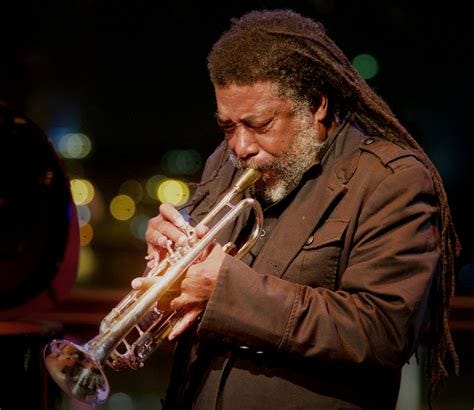
No photographer credit given in the source file
Interview with Leo Smith, February 22, 1978
Ted Panken: You were born in Mississippi and, from what I hear, your father was a bluesman. Can you talk about some of your early musical experiences, things that were given to you when you were very young?
Leo Smith: Well, my tradition comes out of the blues, which is the basis for all improvised music, in the western part of the world. We were constantly influenced by blues people, by having them around daily: people like Little Milton, a lot of other names I’ve forgotten over the period of time. In the community there lived also black musicians who played the blues and stuff like that. I, myself, played during my first period, all blues, just different groups and, especially I played with my father, whose name is Ellie Wallace, who plays the guitar and sings also in the style of B.B. King and those type of blues singers.
That’s what’s called urban blues by some people.
Yeah, right. So from the historical point of view, from a very early age, I was exposed to the roots, the foundations of creative music.
What were your first vehicles toward expressing this music?
This music? Well, my first instrument was the french horn. I had envisioned playing the drums, as all young kids do - you know, that’s coming out - but when I got into the band at high school they had enough drummers so I dealt with the french horn. The teacher was Earl Jones. He was a reedist, plays all the reeds and stuff like that. He has some very interesting techniques for teaching. For example, before I started playing the french horn I would blow the bottle - he had a Coke bottle that would blow it to. He understands what wind instruments are all about. So we would blow these bottles for several days before even approaching the instrument and once the bottle thing was over, we would blow the mouthpiece for several days. So since you’d gone in for an instrument, whether it be saxophone, trumpet or whatever, if it’s a wind instrument, you would go through the same tradition, which would last something like two weeks before you’d really get to the instrument itself. And that was taught on basically long tones. A lot of long tones and emphasis on tonal quality. Also what made a big difference was his concept of teaching outside the building. You know, for an instrument to play outside goes back to African tradition, which is the elements, you know, like having all the elements to deal with at one time, whereas inside a building the elements are confined to a limited space so the range . . . for example, the range, the dynamics for the trumpet in a building is so much different for the outside. So Earl Jones had good techniques for teaching music.
Have you transmitted any of those techniques to your students?
Oh yeah, in various ways. I follow my own way of doing things, you know, like in my rhythm units for example. I’ll teach the rhythm by clapping for example, and also by singing - the voice through the voice vocalizing. Just rhythm itself would come through for example to have an orchestration type rhythm type of rhythm, where you use the hands in different parts, which puts them in different sounds, and that would be to indicate the markings of rhythm units within a piece. So I’ve learnt a lot from Earl Jones and also my teacher - my teacher on the trumpet was Henderson Howard - Henderson Howard was his name. He was a very fine trumpeter, pianist, wrote music also. He was my strongest molder so far as the trumpet goes because he played the trumpet, whereas Earl Jones played the saxophone and a lot of his technique I learned to use and expand upon. For one, he never taught that this was a B-flat scale or E-flat scale or as such. He never taught that this was an interval of the fourth or the third or the sixth or the seventh. He would take the music and put it there and play the music. Once he played it he would ask me to play it and by doing that I got an oral tradition in the music, which is African in its inception. So, he would play the music. I would come right in behind him and play the same piece. Therefore, I learned the manipulation of the valves of the trumpet and the pressure of the embrochure, how to make the sounds lower and higher, and so forth, just through that technique. It was years later - in fact, when I was going into the Army - that I recognized that there were certain scales, even though I played in all the scales.
Now tell me when so-called jazz first entered your musical scheme, or if there’s any distinction between the type of rules you were exposed to while growing up and jazz.
Well, for one thing, jazz to me, covers a particular period, from roughly 1915-1920 through to the thirties. That, to me, represents jazz, and I accept it on that limited basis for one reason: because Morton, Ferdinand Morton, who was commonly called Jelly Roll, - he insisted that he invented that music, jazz, around that period. So I accept that as being the jazz period. Something in comparison would be to look at the baroque period in Western Classical Music and the various periods of music in creative music are whole - like, for example bebop is a whole music, hard bop is a whole music, cool . . . all these are, like, whole musics. Creative music acts as an umbrella. It covers all of this. Now, I think I may tell what I’ve defined as creative music and then we’ll be clear. Creative music represents all music that delivers a particular message through improvising, the technique of improvising. The result of improvising is not composition as such, but improvisation, and that will be proven some time in the future. Right now it’s proper to say that one is a composer, because it offers certain prestige in this particular society. But the improviser, at whatever time it coming in the future - the improviser will say “I’m an improviser” and people will know immediately that that person delivers his music through improvisation.
Well, you were growing up in the so-called “hard-bop” period, and I’m wondering in terms of where you were then.
Well, I was in the basic blues. The basic formula of blues. I didn’t go through those periods of music. I only went through them in the army and my original intention in going through them was to experience the technical science that underlies all the music. And then I found the way of intellectually understanding what was happening. So therefore, I went directly from blues through a period of education in the Army with fantastic players to the music that we call Great Black Music or Creative Music here in Chicago.
I understand from your writings and other interviews with I’ve read that you made your discoveries in the Army.
Well, what I recognized in the Army, after being in there, is that musically, that environment was quite similar to my high school, coming up through high school, stuff like that. We had a great opportunity at any moment, almost, in the Army bands, to go in and do private practicing and rehearsing and stuff like that. The opportunities for organizing different groups in addition to the regular military stuff. It provided an open, outside tradition where the march, Army ceremonies, things like that, carried us right back into the tradition of high school, traditional Africa, Asia, where all of the music has originated outside. So it was very good in that respect - the meeting, the cross-breeding of different cultures, of people, for example, people that played in the swing period who went into the Army and made the Army their career. Well, I had doubly exposed to me, because I could talk to them on that level and find out different things about, you know, just to carry on, and stuff like that of their period, which promoted enlightenment more than it would if I had read a book. They would play pieces from that period because they were older men. The other aspect of the Army was to carry on the tradition of the session, which is now almost completely non-beneficial. You don’t get much from sessions now, because the intent is not with love. So we had, like, daily, nightly sessions, where you could learn to play different pieces, and if you couldn’t play them then you would find someone in the room, someone practicing, trying to work out the changes without the understanding of music. For myself, I never went through (fault - ?) pattern of my behavior, musical pattern. I never went through those periods, like bebop, and stuff like that. I went directly from the blues into what they call free music. But as I said, earlier, before going through that, I intellectually understood all these other musics.
What instruments were you playing at that time?
You mean in the Army? Well, I played the trumpet, I played the french horn - those two instruments. I attempted to take up the bassoon but ain’t nothin’ happened with that. So my basic instrument at that time was the trumpet and secondary was the french horn, which, as you know, I recorded a couple of times on.
So your real multi-instrumental period began out of the Army, in Chicago?
S: Well, with the french horn in the Army, that was my particular beginning, but after getting here in Chicago and realizing the impact that such tradition had. . . it was thoroughly documented and demonstrated by everybody who was around, so I came under this influence. It has served me well. I think that I’m one of the few trumpet players - brass players, whatever - that doubles so many instruments.
Have you ever tried to use reeds on your brass instruments?
Oh yeah, I have, and the result is fair, but it’s not a lasting thing. It’s not something that you can look upon for a long-time duration because it’s so limited.
Let’s get back to chronology and discuss how you wound up in Chicago during those years.
Well, earlier, before I went into the Army, I had come through Chicago with a blues band, fellow by the name of Al Pershing. He had a couple of blues records out, so I was traveling on the road with that group. All the musicians in the group were from Chicago, except myself. So after going into the Army… Now, I went into the Army right after I came off the road with this group. I went into the Army, ran into people that were very important musical people, and I met a fellow in my last tour of duty from…I don’t know where he’s from…but he had been in Korea, and had been in the same band that Anthony Braxton was in. So I expressed desires of coming to Chicago at that time, because at that time my wife was living here, and he gave me Anthony’s telephone number. So when I came here to Chicago I called up Anthony and we got together for some conversation and played a couple of his pieces, and I played him a couple of pieces of Ornette’s that I had learned, and we played a couple of pieces of mine. From there we kept somewhat in contact, but not really strong contact, because Anthony was not sure of me and I wasn’t sure of him, in a sense, so to speak. Well, a little bit later, after that, I met Roscoe, Joseph and Lester Bowie, and from meeting them, Roscoe agreed to introduce me to the A.A.C.M. members and also recommend that I become a member. And that’s how I became officially involved with the A.A.C.M.
So in the Army you discovered Ornette Coleman.
Oh yeah, Ornette Coleman, Don Cherry and Booker Little, that music.
So it was that flexible.
Oh yeah. See, the military part of it - like, we would play something like about 5 or 6 graduations in the morning and each graduation would run something like 30 minutes, maybe some 20, some 15. There’d be shorter ceremonies. So once we were through from, say about 6 in the morning until about noontime, there would be individual practicing from, let’s say 1 o’clock until 3 o’clock, where you could do whatever you wanted to do, musically. And most often we combined ourselves in groups and things like that, and played, or if someone was seriously working on something they would do it, like, in another room, or something like that. From about 3 on, then we would go into rehearsal with the march band, the concert band, whichever one it was time for. And we also had what they call a so-called big band. I’d like to clarify that and say that “big band” is an unappropriate title for that music because it’s not a big band, it’s the music itself that makes whatever unit that it’s dealing. So that would be described as a creative orchestra, just the same way as one would say a “classical orchestra”. And the person who made out the instrumentation and the tradition for the creative orchestra was Joseph Oliver along with Fletcher Henderson. They are the apex of the blossom, the flower that bloomed out and became a creative orchestra.
The people who disseminated were coming out of a tradition they’d assimilated too.
Well, the whole New Orleans trip was assimilated. But I’m just saying the music itself and the instrumentation THAT THEY were dealing with instigated the development of the creative orchestra. A lot of people don’t understand that and that’s why I want to say it in this interview, so that they will have some insight on it.
I might add that after Fletcher Henderson, we have Ellington, and we can see similarities in Ellington and Fletcher Henderson in many ways — for example, the way that he orchestrated the clarinets. Fletcher Henderson did that first and Ellington made a beautiful trademark out of it, writing for clarinets. I mean, the group as a section of the orchestra, the clarinets… Out of that mood, Jimmy Lunceford, Chick Webb, who . . . Chick Webb was more in the Henderson tradition, whereas Ellington assimilated that and innovated it, so to speak. So, it moved from there to Basie, another link in the chain of the Fletcher Henderson style, whereas Jimmy Lunceford and Ellington were from a similar link in the chain. See, we have these two paths that are moving along, that’s evolving creative music in the orchestral context. Then there were many white groups that were playing that same tradition, like Kenton . . . Kenton was a little later, but before Kenton . .
Claude Thornhill . . ?
Yeah, Claude and that clarinet . . . Benny Goodman, who I think had a much more important grouping than Claude - that’s just my opinion. That whole panorama of players in the orchestra laid out the whole tradition of the music, and after that many, let’s say, large orchestras were performing. A lot of them, I don’t even recall their names now, but one point I might make is that the next significant change in the orchestral format was Sun Ra, you see. Sun Ra has taken the music and - same type of orchestration - added all kinds world elements to it. I might say in the same breath that Sun Ra has evolved what I call a world music. He’s one of the successful people that have done that from the creative point of view. On the classical, or your American point of view, we would take Harry Partch as being one fellow that has developed a world music. By world music I mean an assimilation of many different musical sciences and being able to employ this within that music without being, let’s say, Javanese, but understanding the technique of the Javanese music. Sun Ra understood that as well as Partch, and Don Cherry also understands these kinds of things, but his point of view is a little bit different than theirs in a sense. His is more international type of music, if you understand what I mean.
Also, there have been smaller-scale developments of orchestral arrangements, which and I think is what you were referring to when you mentioned Joe Oliver.
Oh yeah, right. Well, that was earlier. You see, Joseph Oliver, in my opinion, was really the true pioneer of the creative orchestra. You see, for me there are pioneers and there are innovators. Pioneers are the ones that lay out a period of the music and continuously introduce different things, whereas the innovator is the one that can take an idea from the pioneer and innovate it to such a point where it can be assimilated throughout all of the music. Then you’ve got, under that level, refiners, people that play original music but deal with a particular system of music and increase it, extend it. To give you a further example, let’s take the saxophone. Sidney Bechet was most definitely a pioneer, O.K.? Through Sidney Bechet, John Coltrane and Yusef Lateef. Sidney Bechet pioneered, John Coltrane was an innovator, and Yusef Lateef was a refiner.
I was wondering also if you’d had access to recordings of creative orchestral music when you were in your formative years, when you were still in Mississippi.
Yeah, I did. I started listening to Billie Holiday, a lot of Billie Holiday, and in the mornings, every morning at 7 o’clock in our house the radio went on and every morning I heard Louis Armstrong play the trumpet, every morning on the radio in Mississippi. Every morning other than Sunday. I heard that music, yes, I heard it in all kinds of contexts, in the small group context, the ensemble context, and the orchestra context. I was exposed to orchestra music from the colleges around. There was a group that came out of Jackson, that actually played bebop. That was my first exposure to bebop, even though then I didn’t know that “bebop” was the title that had been applied to that music. I learned later, while I was discovering Charlie Parker and those people, that that’s what the music was called. But I was fascinated by it.
How did you first discover Fats Navarro? He’s one of the individuals you dedicated your book EIGHT PIECES to.
Well, I discovered Fats Navarro, believe it or not, in Paris, in 1969. I didn’t know his music until then, and I got two volumes of his music and started really studying it and seeing what was happening, and realized that he was one of the people that moved the trumpet to another level, but was not ever given really serious credit.\
Let’s get back to chronology and go over your beginnings with the AACM. What were some of the first orchestral combinations you were involved in with the AACM? I’ll also ask you to function as a critic-scholar again, and try to place your music into the context of the time, because there’s not much documentation from 1967 and 1968.
I’m not a good critic, because I don’t believe in criticism.
I’m asking that because of the statement, so maybe we can get into that too: your philosophy on criticism and your idea that criticism should be based upon a total evaluation of the music.
Well, when I first came into the AACM, some of my first pieces I had written earlier and redone them for a different instrumentation of the AACM. One of the first pieces, the first or second piece, was CONFESSION OF NAT TURNER which we played an awful lot. NUMBER X we played a fair amount of times. Those were the early music, which was in 1967. THE BELL was done also for orchestra, as well by ensemble.
Can you tell me the types of techniques you used in composing those pieces?
Well, in a way I can, because often technique seems to lose me, but I’ll tell you in some kind of way. My basic feeling about music is that all the music has, up until say, the twentieth century, all music has dealt with the understanding of development as an ongoing process to enhance the creativity of the music. Now, one of the ways I look at music is a little bit different than that. I say and feel and have confidence that one single rhythm, one single sound or silence, one single silence, any element of music, does not need to be developed at all. They are complete within themselves, just from the initiation of it. For example, when I play a solo, what you’re hearing is . . . conceptually, what you’re hearing, from my point of view, . . . hundreds of solos, hundreds of them, you see. In my first early part of playing, critics often said that I was fragmented. In fact, the Chicago critics were the group of people that felt that what I was doing was fragmented and was not developing the way they thought things should be developed. But they didn’t understand the concept. None of them had the nerve or the understanding to ask me what it was about. They decided themselves what it was about.
You’re referring to the reviews of 3 COMPOSITIONS OF NEW JAZZ?
Right, right. So if one understands, say, a certain level of thought and then they want to bring in other people’s opinions to get the truth of the matter, then they should ask.
What would you have told them?
I would have told them the same thing I just got through telling you. And then they would have been in a much greater vantage point to understand what I was doing. But that whole principle evolved through all of my music, all of it. Now the second understanding is the rhythm unit concept. It’s sort of halfway a concept and halfway a theory. The theory is that sound equals silence and silence equals sound, or rhythm equals space and space equals rhythm. That’s the fundamental principle in the establishment of that concept. Now, for each player that I write for, I write with that intention in mind, that I’m writing from lots of real pieces of music, and that within one context of an improvisation - which is what I’ve determined that other people has mislabelled by calling it composition - all of mine are improvisations. No matter how they are put together they are improvisations.
Do they have parameters?
Yeah, but the important thing is that the dominant aspect of the music is improvised. That’s the whole law behind it. Well, I might give you two other laws. What the first one is is that composition is a music that is written or composed where the ingredients and every component aspect of it is thoroughly realized in detail of the same mechanics. In other words, like, a three-beat sound, or a three-beat rhythm would exist anywhere on earth in composition with the same understanding behind it. Whereas improvisation is a music that is delivered through improvising and that improvising is the predominant aspect of the music, which is either spontaneously done, or it can be done through the other levels which are rhythmic improvising, choral improvising and thematic improvising. Those are the 4 basic elements of improvising. So all these things are spontaneously done in one particular performance. The improviser is consistently making decisions as he is playing. That’s the whole important point. That’s the important point in the difference between improvising music and composing music. Composing music, the same process is taking place, but the process is already defined. The thought pattern has already been initiated, and there is no deviation from that route, because if you do you violate the whole science of composition, you see.
Don Cherry has called this concept “spontaneous composition”. What do you think of that phrasing?
I think that still is not a good name for it. I don’t even deal with that word, because “spontaneous” refers to anything. In other words, like, one can spontaneously bump into another person; one can spontaneously say the same sentence at once, something like that. But the real technique of improvising, which is a technique; solo, which is another technique; and the difference between the two is improvising in the context of an orchestra piece, one that I write, would be different than a solo. Improvised lines would mean that you supply an unwritten line to these elements that are happening, whereas with a solo you make a major statement upon your own constitution, your musical constitution. Therefore, it’s different. Now, I might say that solo is called a solo line, because there are other people that are involved in soloing. Like, if there’s a rhythm section, a so-called rhythm section, if that’s there then each and every thing that’s happening in the music at that moment is considered by the solo line. Now, another form of solo is where there’s one performer and the concept of unaccompanied performer on an unaccompanied piece is another misleading thing, because how can the accompanist accompany a soloist. There’s no room for that. Solo means one and lone. Now, there was another part you asked me?
What the Chicago music - the Chicago School, as it’s been called - means to us, is that it was the first time that form, as such, became the predominant aspect of the music. Structuralism also was motivating. Now, I’m not saying that in other musics these ingredients were not there, but we made a special effort and intent towards creating music structurally, applying different systems and also form as it would work. We had two types of forms that were most often used: one that would be implied from the very beginning; one that would evolve continuously on its own accord. The School of the AACM, all the musicians there, has verged upon the possibility of the greatest breakthrough in the history of earth, as we know it, and modern civilization, because there are civilizations that have existed other than what’s recorded now. But within that point of view, the AACM is on the verge of delivering some of the most fantastic things that have ever happened to you. By that I mean through form, technique, and stuff like that; structures, conceptualization of pieces, philosophical understanding, political alliance, the way that we as such hold our ideas together and look a greater point in the future for all of our people. We realize the suppression of music, of this creative music that’s happening in this country, and by realizing that, it will only make us stronger and not weaker, so we’re not going to lose. That’s my statement in regards to my contemporary people, who I’m involved with. I feel that way about them.
What conditions made it possible for this group of people to come together, as you see it?
Well, it was an act of God, man, because never before has that many people come together and put aside the basic things that differentiate the difference between two people that’s dealing in an artistic area. They lay out all this stuff, man, and a way of love. Love is the founding principle I feel. For example, I can always talk to Roscoe, always talk to Joseph, always talk to Anthony, always talk to Leroy, Muhal - anybody in the AACM can ask them certain things about music, their music specifically, and will set right down and explain it, in detail, absolute, without any cloud or confusion whatsoever. The same thing is happening with me - I will do the same thing for them. The same thing also would happen if any other musician would desire any information from us. We would give it in the same spirit, you see. That has made the difference. Now, why this time, why Chicago, historical points could be brought up, like when the people, our people moved out of New Orleans and those that went through the route of New Orleans to California and so forth came here to Chicago and developed the music here in Chicago before doing it in New York. That’s a historical point of view.
A lot of people say Chicago is the most southern northern city.
That may be true. That may be true. But getting into the music point of view, in the Midwest, it’s like . . . well, this whole country, as far as creative music is concerned . . . it’s laid out like Africa, man, the differences of the music from, say, the Midwest, from the West from the South, from the North, from the East, and when you get all the interim schools, like any of the Western and Midwestern schools, you got the Kansas City style and those elements. All these things point up to the fact that music is the absolute perfect form of creativity, and its the oldest, the oldest of all art. It is the oldest.
Were you involved in any musical activities outside the AACM, in Chicago, for instance, blues situations?
Oh yeah. I played with Little Milton, Milton Campbell is his name, when I first came to Chicago I would go out on the road with him. I played in his little band. I played with a couple of other fellas - I can’t recall their names now - in the blues tradition here, in Chicago. That was basically the extra stuff here I did outside of the AACM, but primarily, the AACM was, like, the whole idea.
So you were supporting yourself through the blues gigs?
Sometimes. You see, I didn’t play the blues all the time. I only played it during certain periods, when these players would come in town I would go out on the road about a month. No, I was helped by my wife, and family. That’s how I usually sustained myself, even up to now, because at this point now, I’m just able to make, like, a fair living from playing. But up until this point, like, my family has been my aid.
From what I read - correct me if I’m wrong - the two basic orchestral units you were involved with were the group Integral and with Lester Lashley and Henry Threadgill, and then what later became the Creative Construction Company, with Leroy Jenkins, Anthony Braxton and later, in Europe, Steve McCall. Can you talk about how you came to realize the similarities, interests, and some of the material you did at the time, in some detail if you would?
Well, the first group that was organized was Braxton, Jenkins and Smith, and we called that - well, that was our title for the group. After meeting Anthony a couple of times a week, playing together in his house and different places, we decided to put together Braxton, Jenkins and Smith as a trio unit. Our basic mode of working was I was dealing with the rhythm unit concept and my aspect of sound equals silence and stuff like that, and Anthony was dealing with the scale structure units, and Leroy (end of Side 1)
Like I was saying, I was dealing with the rhythm unit concept, which has always been in my music, and I was to discover the whole nucleus of it and put it in a formalized system in 1970. As I said, Anthony was working with his scale structure unit and . . . scale structure concept in music. . . and some harmonic aspects of music. The detail of the harmonic aspect of it was the basic understanding that all harmony is one and all time is one. Leroy worked on the other end of these other things. His thing was more lyrical in the blues tradition, the gospel aspect of it. He was working in these areas. So we had a well-rounded group. And we played for, oh, a year-and-a-half around here in Chicago at different places for very small audiences and very little support from the critics. In fact, the whole time we played...
There was a great deal of hostility, wasn’t there?
We were the outcasts of the AACM, Braxton, Jenkins and Smith. There was a total ban on anything, like criticism or anything like that. We never got a review in the whole year and a half we were playing together here, never got a review in Chicago. When the record came out, people were putting us down musically, as well as personal. So it was kinda hard in that respect. But when we went to Europe, we suffered the same thing. We went to Europe in the same way as the Art Ensemble - they left about a month from we did, a couple of months. And we got there, and we found ourselves in the same situation of being the outcasts and being a group that was looked at in a hostile way, that we were doing something that was not right, and things like that. And the Art Ensemble was very well accepted. We had small riots, and stuff like that, at different concerts - people who didn’t like our music didn’t want us to continue to play. We played on the Belgian Festival there in 1969 and . . . 1970, was it . . . people would pull up. . . It was Avignon. They had 20,000 people there, doing all kinds of freak-out stuff, you know, the way a festival goes. . . People would pull up clods of grass and was throwing them on the bandstand directed at Leroy, Steve McCall, Braxton and myself. So we suffered a great deal in that group. We later named the group Creative Construction Company because people kept referring to us as Anthony Braxton’s Quartet - the records came out as Anthony’s because they were his records, they should have, but the group named itself . . . we changed it because we realized the inferences that they were placing on it, and we all were in agreement to call it the Creative Construction Company. We played with that a couple of times in Europe, but they never really taken the name serious. So, finally coming back to America, we played here and in New York under the same name a couple of times, and then those two records came out from the first concert we gave in New York of all Leroy’s music. That’s basically the history of that.
You’re also documented, I think, with Kalaparusha, on HUMILITY IN LIGHT OF THE CREATOR. Were you playing with him frequently in the late sixties?
Oh yeah. Well, Kalaparusha was the first group I played in as a group member. We worked together, oh, maybe a year as one solid group where we rehearsed and performed the music and talked about the music, and things like that. That period I was working with the unit then also and Kalaparusha was trying to find another concept of harmony. He was dealing with a dissonant springboards (?) for harmony and, I think he had worked that system out for the piano because he used to write out a lot of his pieces on the piano at that time.
Was Integral formed when you came back to Chicago?
Right.
Can you tell me something about Integral on the same lines?
Well, Integral, we wanted to make that a group of, for lack of a better word, let’s say involved with theatrical presentations, along with musical endeavors. So we did a lot of theater stuff during that period and it was quite a movement in that respect, because we did a lot of research, like Henry and Lester and myself. Thurman was originally in the group but he had to leave out because he was doing a lot of other work. But eventually, Lester and Henry and I, we would research a lot of African things and base our pieces off of those principles. We would research the Asian part, and particularly of Japan, and based a lot of things off of that. So it basically was a musical/theatrical group and, in that way, it’s a better light to understand it.
Is that when Henry did the score for the play, “Hotel?”
SNo, we didn’t perform that. I don’t even know that piece.
Now, in 1970-71 the scene in Chicago was different than when you’d been there before, a number of people were still off the continent. Did this have an impact on your decision to move to New Haven?
No, my prime reason for moving to New Haven was that in the musical scene a little bit not . . . it was almost the same way when I first came back, for example, Integral never got a review while I was here. From growing up in a small town as a kid, I’ve always liked small towns, and at the time, New Haven had a lot of publicity because this fellow that wrote LOVE STORY, Erich Segal, there was a lot of interviews with him, and he was talking about New Haven and places like that. So it seemed like a fairly nice place to go to, and me and my lady, we packed up, and just left and went there. When we got there, we met Marion Brown, who was living there, so he and I formed the Creative Improvisers Ensemble, which lasted something like 2½ years and it’s documented on the . . .
The Arista/Freedom double set?
Right, right. That was made about six months after we had performed together. And we also made a documentary film that’s called SEE THE MUSIC. I don’t know if you’ve heard about that or not, but it’s a full-length film, about an hour and a half, and it documents our philosophical views and political views and musical knowledge, and stuff like that. It was done in Germany by Theodor Kotulla.
Before we continue into the East Coast, I just want to bring up that you’re also documented on Richard Abrams’ YOUNG AT HEART/WISE IN TIME. Were you performing in small, orchestral contexts with Richard Abrams?
Well, I played in small ensembles, yeah, and also in the orchestra format in the AACM Experimental Orchestra.
If you would, please comment on the Experimental Orchestra.
Well, it was very important. It was . . . we played a lot of pieces that was, you know, like, laid out in a way. And at the time, Abrams, Roscoe, myself, and Troy Robinson were writing for it, mostly. Joseph would bring in some new pieces and every once in a while Braxton would bring in a piece, but the primary writers were the four people I just named. We also did totally improvised pieces where all the basics of the music were improvised freely and that was earlier, that was 1967. To my knowledge, it was going on before I came here. I think the Sun Ra tradition had played a large part in that too. I don’t know because I didn’t hear Sun Ra at that time. I only heard Sun Ra in 1969.
From what I gather, Sun Ra left Chicago before this got started.
Yeah, but he influenced a lot of the people, because I can see that in his music. The AACM aspect of it was an original aspect, but I can see in the music concepts, and stuff like that, which has to be an influence, you see.
Certain individuals grew up around where he was playing. Henry Threadgill mentioned that he lived down the street from the Pershing, I think, where Sun Ra was playing every week. So the Experimental Band is almost a totally unique institution . . .
Yeah, it is. What made the Experimental Orchestra so important can be seen from many points of view. One, it gave each member in the organization the opportunity to present orchestra music in concert. It gave the opportunity of breaking into different ensembles from the orchestra and giving concerts. You could write a piece of music that night, for example, in your home, and come out the next day, the very next day to rehearse it and have it performed. It was like being an orchestra and a musician in residence. In some of the ancient courts of Africa, Asia, or even Europe, you see, it’s the same technique that happens on all of these continents. If you’d write out something and it didn’t work right, then you’d take it back home and work on it and bring it back the next night or next week. So it was a continuously growing period for everybody. I even miss that now, because right now I’m usually able to get a couple of orchestra pieces played once or twice a year, you see. So that’s quite a difference from having orchestra music played almost every week. But I still write as heavily as I did then and I write of music. I’ve written something over two hundred and some pieces.
Is there a possibility for an album on the order say, of Braxton’s Creative Orchestra Music?
Sure. There will be music, definitely. I’ll be doing . . . I’m supposed to do some things with ECM as an option in regards to my own label. I will be doing other things on my own label also, but I’m adding ECM to my list now. So I look forward to getting some orchestra music out very soon, within the next year, this year, 1978.
Let’s get back to chronology and go back to New Haven. Yyou arrived there in . . .
1970, September.
. . . and immediately began to create an association with Marion Brown. When you moved to the East Coast did you find it a dislocating experience? Did you find the musical attitudes you encountered there different from what was going on here, or was there essentially a continuity?
No, it was all different, man. Like, a lot of people had heard the music on record, but had never seriously experienced it in performance or listening. So there was not an audience, for one thing. Marion had lived there but he had never played there, in that area. His understanding of the music was also different because he didn’t participate in the AACM blossoming and growth. So he had different points of view about it, which were easily cleared up once we began to work together. He got a good advantage of learning things that went on in Chicago from me, whereas I got a good advantage of learning things that went on in New York from him.
Now, the East Coast creative music was the most documented of any of the regional musics in the 1960s; it was the music, I guess, that most individuals were aware of at the time. Can you compare some of the conceptual bases for that in comparison with those explored in Chicago?
Yeah, well, as I said earlier, the concept of form and structure was the primary point in Chicago, and sound textures and a panorama of different ideas moving about at different times and collectively. It would be more a multi-directional music that was happening out of Chicago, whereas in New York, the East Coast, the music was samer, of a samer direction. It’s the same difference between, let’s say ragtime music, which developed in the midwest and stride, which was developed in the East Coast. That same kind of difference.
Did you begin to serve as an educator in the New Haven area immediately?
No.
When did your educational activities begin? I know you influenced a number of people who’ve become prominent now, such as Anthony Davis, George Lewis, Wes Brown. Can you comment on your first associations with them.
Basically, after Marion had been there about a year, he moved out to Maine, because he’d taken a teaching job up at Bowdoin College. So that left me there alone and I would go out and hear the young players and see what potential they had. Davis was one of the players that had always wanted to play with me, so I had taken him in. And a drummer, Jose was his name, I believe it was. That lasted not too long with the drummer so the next date Anthony and I worked as a duet, and this was 4 or 5 months. And then Wes Brown came into the group, and then it got down to perfect serious business. What I’m trying to say now is that not only did we rehearse the music, but we rehearsed, like, several times a week and organized a real group sound. They had a chance to understand what was happening with my rhythm units. They functioned almost basically as my students, in a way. George Lewis came along a little bit later, in . . . he was ‘72, because I know he was around about that time. We worked in some different contexts, not public, but in my house. He was able to see the different directions I was going in. So, from this whole move, let’s say, from Chicago, I brought all the ideas that I had about music and the ideas that the AACM had about music to that point in New Haven, Connecticut. Eventually, we began to build a small audience there, and it’s still small, because it’s a transient audience, like there’s a university there and each couple of years you have to build back up again. So, that’s that period.
Did this music radiate out to other centers on the East Coast, the New England academic scene? In the early seventies most of the liberal arts colleges on the East Coast had creative music faculties, such as Clifford Thornton, Marion Brown, and Archie Shepp and Max Roach and so forth. Can you comment on the type of impact that’s had on the music?
I think it’s had a very positive impact. I do know that in a lot of those black studies programs there was a response but there was no real interest from the heads of the departments. It’s like the dean of the school and stuff like that. They only did it because of the political pressure put on them, and so therefore, they didn’t have the backing of the university behind them. Now I understand it’s a little bit different, that there is a serious understanding that’s going on between the faculties and the people that are involved in the school. My teaching part, in the academic end at the Creative Music Studios in Woodstock. I will go up there maybe twice a year - it’s very small - and I will teach my rhythm units and I also started teaching at the University of New Haven, which is a fairly big school, I mean, as the small schools go out there. But I found there was absolutely no interest at all in the music from students or the heads of departments at the school, or anybody. I mean, from the Head of Department of the music school there was no interest. I was teaching basically traditional music. There was not possibly a chance to teach anything I was thinking about. So, I had good classes with students, but no interest in the music in the college community. We’ll play concerts and there’ll be maybe 3 or 4 people there plus the parents of the students. No interest at all. So I taught there a year and a half and after the first semester of the start of the second year, I just never went back anymore. I never did resign or stop, I just didn’t even go again.
It was very discouraging?
Yeah, from that point of view. But in the meantime I started teaching up at Woodstock on a regular basis, like, I became part of the faculty up there. And I began to teach then like, I would go up once a session, and they would have maybe 4 or 5 sections a year. But now my situation is, I go up every other week, during each session, and teach two days or three days. Or I teach a solid week during one session, and I work it out that way.
New Haven has developed a music scene of its own, it seems primarily through your efforts, other musicians have come up, such as Michael Gregory Jackson, and so forth. Is most of what’s happening there now still happening in relation to your teaching? Also I’d like to know how you perceive your position there, in more philosophical terms?
Well, you know, all the people that you’ve mentioned, I’ve passed on or served in the capacity of being somewhat of a teacher, but on an informal level, because they all worked with me in different kinds of ways and asked and accepted musical advice from me. The scene now has grown very good - when I say grown very good, there’s about 9 musicians that I just . . . ever since I’ve been there I’ve been trying to organize the musicians, O.K., BUT I’ve always failed, up until last year. We’ve had an organization together now for a year. It’s called the Creative Musicians Improvisers Forum. That is a group that was founded by me and 6 other people, and the basic idea behind it is to take musical concerts to every part of the state of Connecticut, to be, like, a floating organization. We just got started in our first concert series back there in December, and our first concert series consisted of “Double Concerts” - we put two groups on in one night, and they will play, like, a half of a concert and another half all at the centerpiece. They play one half small centerpiece, and then the second half which would be kind of large, which is some of the techniques I’ve been experimenting with out there . . . more listening for the audience, with little sun pieces. And usually the sun pieces take on a quite different characters than the two outer portions. So, I would assess my position there as being pretty strong, because I have organized this group, we are chartered in the State of Connecticut, and we’re going to be given funds in some kind of way from the State and Federal possibilities.
Tell me also about the formation of Kabell Records, your record company, and also some of the reasons behind the unique contractural arrangements that you made in terms of your records.
I started Kabell in 1971, when I did my first solo record. And the idea was to just document my music as I went along, not to basically put out other musics but just to document different periods of my music. So, that’s the basic thing. The second point of view of basic is that I realize, just like everybody else, that recording companies, most of them, are not fair. In fact, I would say almost all of them are not fair. You may have but 1% out of all of them that you can deal kind of honestly with in the beginning, say, as you see. Because at a higher level of things, like Miles Davis, like Cannonball Adderly, when they produce their own records and stuff, through the recording companies - Ellington could also do the same thing - that’s a viable way of working. I wouldn’t reject that point of view. Kabell does take each artist that works on a record of mine. They give them what I call performer’s royalties. It’s different than the traditional way plans are laid out. Like, I’ll tell you another group which does that also, the Jazz Composers’ Orchestra. They do the same thing - they give performer’s royalties. That’s a new concept in recording. I think that if we can ever get to the Senate Investigation Committee, that deals with this area of music, or deals with the area of music period and the recording industry, that we’ll be able to change some of these laws. Some of the things that we have to change is to get away from only the leader getting royalties - make that every person who plays on a record gets royalty money because that’s what the small recording companies are doing, and the large companies can afford to do this and they don’t. The other thing that we have to get straightened out is solo. All right, solo . . . it is my feeling that the soloists on every record that performs over 60 seconds - a piece of music lasting over 60 seconds - should be given contractural royalties from the recording company and should be guaranteed by the Library of Congress the absolute ownership of that 60 seconds or more of solo work. And the reason for that is that now, as in the past, but more so now, solos are being transcribed off of records. They are being published by different authors as their music. In other words, if I play a solo on record, they can have it transcribed, put into book form, publish it, and get it copyrighted under their name - not my name! - and I don’t get a damn thing for it. I don’t get not one cent of royalties from it. So, that’s one of the other levels that the creative musician-improvisor must deal on once we get fully established and once we get enough power to work through our Senators in Connecticut and Representatives, to get them to bring before Congress these particular grievances. Because they are serious grievances.
And you’re practicing that on your own records . . .
Right, right . . .
I think the most recent one is with Oliver Lake, which isn’t that widely available. . .
Well, it will be soon, because I’m going back through some distributors in this country. I put it out on export for about a year - all the music of mine. It will be out soon.
How long have you been in association with Oliver Lake?
Well, Oliver Lake played in New Dalta for 2 years and . . . almost 2½ years, actually . . . we’ve been close friends ever since he moved east and I moved east. He came from Paris and I came from Chicago. It’s been, like, close contact, you know, we talk to each other on the telephone; we did duets together sometimes, you know, like, performance concerts. When he was working with New Dalta we would perform his music as well as mine.
Also, how should “New Dalta Akhri” be translated?
It’s the perfect union of ensembles, meaning, taking a Delta away from the Greek alphabet means “three”, but placing an “A” in there rather than the “E” typifies a particular utopia environment or place which has really no point in actual existence, but in philosophical terms and mystical terms represents my view of music discovered by master musicians and also being able to understand the symbolism or mysticism. So that’s what “New Dalta Akhri” means. “Akhri” itself means . . . “New Dalta” means what I just told you . . . “Akhri” itself means the perfect union of ensembles. For example, I could play as “New Dalta Akhri” and be that perfect union of ensembles from 10 to 100 to whatever number of possibilities can develop at one particular location anywhere on earth can also as “New Dalta Akhri”.
Would you elaborate more on the uses of graphic symbolism in creative music.
Well, you know, I published all my music scores - anything I’ve recorded I’ve published the scores on them - and that served to create a larger environment for my music, and also to place creative music itself on a different level. My pieces have been performed by college students who write to me and say, “I’ve got a recital coming up. I’d like to buy one of your pieces” - like “Reflectativity”, for example - “to play for my recital.” And they do it, you know. So that’s opened up a whole different area of the music that had died away during the bebop period and clean up until now. When Ellington published his music, but the original man who laid out the foundations for all of this understanding of publishing your own music was William Christopher Handy. He’s a very important man in the music, and he has been left out, because people think that he tried to dress up the blues, so to speak, but what he was trying to do was to observe the blues, and he did that. He and Pace set up one of the first important recording companies. Black Swan Records was one of the first important black record companies. They distributed music throughout the United States. This holds a very important place of historical significance about, let’s say, documentation of music. So all these things have been an influence on putting things out.
Much of the new, experimental notation began in Chicago, didn’t it, with Richard Abrams’ music and then through to his students. Is that right or wrong?
I suppose. You see, I never studied with Abrams or any of those people. I always participated as an equal with all of them. I know that he was teaching a system - the Schillinger system - which he had his own concept of. Jarman has his own concept of serialization of music. Roscoe has his own concept of tonal music, and Braxton his scale structure, and so forth. It goes on and on, until you get down to just everybody in the AACM has a set method from which they work.
In recent years, apart from your own creative focus, you’ve also worked within the realm of other individuals’ focus and some records I can think of would be Clifford Thornton’s GARDENS OF HARLEM, Braxton’s CREATIVE ORCHESTRA MUSIC, the two most recent Frank Lowe records THE FLAM AND DOCTOR TOO-MUCH. Can you comment on your associations with these individuals, apart from Braxton who you discussed, and your role in their scheme of thought.
Frank has always said that he wanted to play with all the musicians and so when I played in New York with New Dalta Akhri, he came by earlier that day, actually, and we worked on some pieces and he sat in with the group - that was our first coming together, because we had always been meeting each other, talking about getting together and doing something. So, when he had his record date, he just called me and asked me to come in to New York and play on it. From his setting in with New Dalta I had an idea of what he sounded like, so we made beautiful music together. THE FLAM & THE DOCTOR TOO-MUCH. You can see the difference in how his music has evolved since that period. At this stage, Frank Lowe is one of the most original tenor saxophone players on the scene. Most original. He’s really evolved to a totally different way of playing the saxophone and I respect his music and love it.
In terms of orchestral music, you’ve appeared with Clifford Thornton. Have you done anything with him since GARDENS OF HARLEM was recorded?
No, but before that I did some pieces with him. We worked in New York with the Jazz Composers Orchestra before he recorded with me. That music - some of it is a variation of transcriptions of African music, some of it is original pieces that he composed, and with Clifford, like, Clifford worked first with me before I worked with him. I was having a Jazz Composers Orchestra workshop which he participated in and I got to know his music through that way, and he got to know mine. So whenever he had any orchestra pieces he was performing he would always call me to play on it. Also, philosophically, in the political idiom, we have a lot in common.
You and Braxton also formed a group in 1975 with Dave Holland and Phillip Wilson. That was rather short-lived.
Well, Anthony was looking for a different music than his other quartet music and I sort of served as a transition period and so did Philip - over that barrier into his other music that came out with George Lewis and the other various players on there. I would describe it as just being a transitional period in the music.
Could you also comment on your ideas of world music?
I’ve been working since 1970 on a notational system and the notation system was actually completed in 1971. An example of the music that was a result of that was on my solo record, EP 1, which represents Experiment No. 1. I had fixed this system that takes in velocities, duration, improvising and solo elements all worked out in a symbol code, symbolic code. In other words, there are symbols, and this theory has been completed for almost 7 years. I’ve only utilized it in solo music. I haven’t utilized it in other combinations but now, with my new group, which is Bobby Naughton on vibes, Dwight Andrews on reeds and other things he plays, and myself, that’s the nucleus of it. So we’re just now getting ready to go into this new notational system which is called “Akhri Inventions”. What it means is to play and invent at once. It takes the absolute perfect best of improvisation and composition and add it or combine it and get the third element of it, which is Akhri Inventions, and that’s what it comes out to.
You’ve appeared with Bobby Naughton on THE HAUNT, on Otic Records. Is the music similar to that?
No, it’s all very different from that.
You’re one of a number of people in the AACM who’ve come up from the South. I guess the list includes Alvin Fielder, John Stubblefield, Amina Myers, Joseph Jarman - also people who have connections with the South. Do you see a flow of Southern musical idioms and traditions to this music and those having some sort of impact on the development of it?
Oh yeah. Some of the most important things have come from the South, man. Lester Young, just to name one, Armstrong, just to name another, Freddie Keppard, any of those people man, and even right now, John Gilmore - he’s from Mississippi, you see. The South has been a fertile ground for music because of this outdoor thing, because of all the bands, the high school bands, the different organization bands - it’s a tradition. The South is more African than any other place other than Africa in the United States, I mean. The most African place of the United States. You still have all kinds of healin’ processes that go on there, you still have the wise men, you know. It’s really African, man, all over. So that music that comes out of there is an African feeling, so it adds to all the things that make up American music.
***************
************
Downbeat Article for Critics Poll Awards, 2017
Late last December, just after Ishmael Wadada Leo Smith turned 75, well before Downbeat’s critics anointed him “Best Trumpet,” “Best Artist” and “Best Album” for 2017, John Lindberg spoke about “the rare arc” that has brought his old friend to “arguably the most productive time of his career.”
“That Wadada has elevated so much in notoriety, recognition and output of work speaks to his endurance, determination and sheer grit, his complete dedication and focus on his work for 40 years,” said Lindberg, who first played with Smith in a creative orchestra concert in 1978, has played bass regularly with Smith’s Golden Quartet and Organic ensembles since 2004, as well as in a long-standing duo, documented in 2015 on Celestial Weather: Midwest Duets. “It’s a coronation of the idea that true art can rise up in its purity and be recognized.”
Smith detailed his work ethic at his midtown hotel on the morning of April 22, day five of a six-night, six-event residency at the Stone, John Zorn’s Lower East Side venue. Only two of the concerts overlapped with his CREATE Festival, an eight-set, Smith-curated event that transpired on April 7 and 8 at Firehouse 12 in New Haven, Connecticut, where Smith lived during the 1970s and returned to in 2013, when he retired after two decades on the faculty of the Herb Alpert School of Music at California Institute of the Arts.
“The practice of making art has been my lifestyle,” Smith said. “I work the same way I worked when I taught school. Every day I get up at sunrise. I do my morning prayer. I have food and coffee or tea. I work until 11, 12 or 1 o’clock—another hour or so if I have a deadline. After that, I may visit my granddaughters and daughters. Then I come home. I cook my dinner. I watch a movie. I go to bed. I have no distortions or intrusions.
“I’ve always written a lot of music, on a scale that if I’d stopped writing ten years ago, I could still record for years. I’ve always been able to receive inspiration and transform it into scores, be they musical scores or literary scores. I read scores—opera scores, orchestral scores, string quartets—for my own satisfaction just like you’d read a novel. I’m looking for an intuitive, mystical connection with how those ideas came about—not with what they are. By doing that, you get a feeling for the decision as it was made, like when Shostakovich wrote that line where the strokes of the violin and various instruments in the quartet are only about dynamics.”
At CREATE Festival, Smith celebrated his Connecticut experiences. He presented a new score for saxophonist-flutist Dwight Andrews and vibraphonist Bobby Naughton, both collaborators in New Dalta Akhri, the ensemble that Smith organized during his first New Haven stay, and members of the Creative Musicians Improvisers Forum, which Smith founded there on the model of Chicago’s AACM, which he himself joined in 1967. Pianist-composer Anthony Davis, a Yale freshman in 1970 when he heard Smith, who had just moved there from Chicago, play a duo concert with Marion Brown in 1970 (he first recorded with Smith on the self-released Reflectativity in 1974 with Wes Brown on bass, recontextualized for Tzadik in 2000 with Malachi Favors), joined the RedKoral String Quartet to play Smith’s “String Quartet No. 10.” Drummer Pheeroan akLaff, who recorded with Smith and Davis in 1976 on Song Of Humanity, performed with the Mbira Trio, with extended techniques flute master Robert Dick and pipa virtuoso Min Xiao-Fen.
Smith also applied his 75-year-old chops to a solo recital mirroring his 2017 release Alone: Reflections and Meditations on Monk (TUM), and, both evenings, to repertoire from America’s National Parks (Cuneiform), the aforementioned Downbeat “Best Album,” on which cellist Ashley Waters, Smith’s one-time student at Cal Arts, joins Davis, Lindberg and akLaff, the core members of Smith’s Golden Quartet for the past decade.
DownBeat caught three concerts at the Stone, including an April 20 performance of “Pacifica” by the Crystal Sextet, on which four violists and electronicist Hardedge, prodded by Smith’s real-time instructions and exhortations, interpreted a graphic score depicting vertically stacked bands of color, progressively more opaque, representing how sunlight refracts in water as it penetrates to its depths. On April 22, Smith presented the kinetic, blues-infused suite, Najwa, using two guitarists (Brandon Ross and Lamar Smith, his 21-year-old grandson) rather than the four who perform on a new Bill Laswell-produced release of that name (TUM), along with akLaff, Hardedge and Laswell on electric bass.
On April 23, Smith concluded his run with “Lake Superior,” a 19-page score drawn from the six-part Great Lakes Suite (TUM), with Henry Threadgill, Lindberg and Jack DeJohnette. For this occasion, Smith convened alto saxophonist Jonathan Haffner, bassist Mark Helias and drummer Marcus Gilmore, who conjured a kaleidoscopic performance after a half-hour pre-concert runthrough. Smith played throughout like a man possessed, leaving it “all on the field” on his final declamation, during which he roared through the trumpet with the power and heat of a practitioner half his age. At one particularly intense moment, he stood on one foot. After another, he leaned against the wall behind him. He took periodic pauses to mop his brow.
When they were done, Smith lifted the score for the audience to see. “I changed this—right here, right now—several times,” he said. “I create this magnificent gray zone where no one knows what’s going on except me. I’m exploring the dimensions of creativity. It’s not written. It’s not thought about. Then they solve the equation. My heart feels pretty incredible.”
He moved to the center of the “bandstand.” “I played the hardest I can possibly play,” Smith said.
The comment mirrored Smith’s remarks the previous morning on the phenomenon of playing with such boldness and in-your-face presence at his age. “I play as strong as I’ve ever played—in some contexts, much stronger,” Smith declared, noting a 2½-octave range, “starting from the bottom octave, around the G or the F#, all the way up to the high F or E, and sometimes G.”
He continued: “That’s a physical and emotional artistic gift. It has nothing to do with the way I practice or conceptualize making music. There’s a lot of misconceptions about making art. One is that you have to practice every day, as hard as you can. Another is that you have to warm up for hours before you play. None of those myths exist for me. I’m not bound by the idea that something has to sound a certain way or be done a certain way. What’s important to me is that, when an inspiration comes, I allow myself to receive it and try to read it the best I can, without inhibition or blockage.”
Smith offered a recent example in New Haven. “I got cramps in both rib sides five minutes after I started playing with the Golden Quintet,” he said. “I decided, ‘Ok, we’re going to see who wins.’ I stretched, which relieved the sharpness, and when I started playing I bent a little lower and didn’t think about it until it was over. When I pick up the trumpet and step out to play, I’m oblivious to everything. Therefore, I play as hard as I can every moment. To make live music—to make art live—is one of the most heroic feelings in the world. You have the possibility and actuality of losing yourself inside that for an hour. It’s cleansing. It regenerates your body, your human condition, your mental and spiritual state.”
Apart from spiritual dimensions, Smith added, “the trumpet came natural to my physique and my intelligence” from almost the moment he started playing it at 12 in Leland, Mississippi. “A few weeks later, before I knew all the notes, I wrote my first piece—for three trumpets,” he said. “I started playing live at 13. That got me out of having to go to the cotton field. In high school I played three nights a week, sometimes four. Even if we drove 150 miles from the gig, I still went to school every day. I learned how to do what I had to do. Trumpet is a tubular instrument, and to play it, you have to understand what happens when its physicality doesn’t match yours. When there’s a breakdown, it becomes traumatic for most people, and they try to correct it. But when the trumpet denies me access, I accept whatever it gives me, play what’s possible at that moment, make something out of it. After I do that, I gain the greatest sense of confidence. I don’t ever worry about if my lips are sore. I’ve played probably four or five mouthpieces for as long as I’ve played the trumpet.
“My sound is authentically me, and it comes from here.” Smith touched his diaphragm and his heart. “It doesn’t come from a mouthpiece. It doesn’t even come from an instrument.”
Smith developed his mighty embouchure by playing and practicing outdoors, both in high school and during his 1962-1966 tenure as an Army musician. “Your sound doesn’t bounce off columns or four walls,” Smith said. “The projection level is just after the bell.” He held his hands about 6 inches apart. “Once it gets past the horn that far, you can hear it almost anywhere, a half-mile or a mile away if there’s no trees.”
Roy Hargrove, presented with “Crossing Sirat” from Smith’s 2009 album Spiritual Dimensions on a Blindfold Test last year, described Smith’s sound as “majestic.” In a separate conversation, Jonathan Finlayson called it “regal.” A more granular, metaphysical appreciation came from Laswell, whose second duo recording with Smith, Sacred Ceremonies, comes out this summer on his M.O.D. label, along with a Smith-Laswell-Milford Graves trio titled Ceremonies and Rituals and a Smith-Graves duo titled Baby Dodds in Congo Square. In each instance, Smith weaves in and out of the rhythm, juxtaposing sound and space with fluid rigor, signifying on the cool, simmering Laswell-engineered ambience with a lustrous, blue-flame tone that contrasts to his white-heat declamations the last two evenings at the Stone.
“He doesn’t do much high-register stuff, which you also find in people like Miles Davis, Don Cherry and Olu Dara,” said Laswell, who documented his first encounter with Smith on the 2014 CD Akashic Meditations (M.O.D.). “When he’s playing warmer tones in the mid-range and lower register, he catches this blues quality without the form. There’s some kind of force with a natural element, not just based on the music experience. Wadada’s been here long enough to accumulate these different feelings and elements and experiences about the human condition, and he’s pouring it back on the world. He plays rivers and lakes and mountains and fields. You don’t find that so much in music. That’s why people are responding.”
In akLaff’s view, Smith now plays with more sustained intensity than when he first entered his orbit. “I remember people writing about my playing the austere and spare music of Leo Smith, and it wasn’t necessarily laudatory,” akLaff said. “During his thirties and forties, Wadada had direct experience with the energy people were playing with during that period, which cannot be repeated. He chosenot to get in the fray. You could say composition won out over braggadocio. Now, as a septugenarian, Wadada has that in his pocket, and he’s chosen to be uniquely outstanding with it.”
“Wadada always had this inimitable, immediately recognizable, wide sound with this incredible concept of using space and texture and color,” Lindberg said. “But if someone asked me which trumpet player is going to blow the roof off the place every night, he wouldn’t have jumped to mind at the top of the list. But ever since 2004, when I joined the version of the Golden Quartet with Ronald Shannon Jackson and Vijay Iyer, I cannot recall a performance where he hasn’t played really hard. I don’t think he can help himself.”
Smith’s “gray zone” reference after the April 23 concert illuminated his penchant for deploying micronic control of timbre to maneuver and shape the flow within the diverse instrumentations and contexts that he explores. “Wadada’s notation system seamlessly represents composed, fixed elements while allowing for the spontaneous innovation of the player to be embedded within it,” Davis said. “His music was always developed and multifaceted, taking us as performers on a journey through different structures, moods, settings and techniques. You always have to be on your toes, because the structure can change on a dime. You look at the whole score, not just your part—according to what Wadada plays, you might have to go to a different section. That keeps the music fresh; the composition is a living, breathing thing.”
Davis regards America’s National Parks as “a natural progression” from Smith’s epic Ten Freedom Summers (Cuneiform), recorded in late 2011, with the Golden Quartet and a nine-piece chamber ensemble. Smith took as his subject pivotal events, themes and protagonists in the African-American struggle for civil rights over a 145-year timeline. “Ten Freedom Summers was more turbulent than this album, which emphasizes the more lyrical side of Wadada’s music and playing, and has a beautiful flow,” Davis said.
In 2015, Smith was looking for “another project that would make sense and give me the opportunity to showcase another aspect of my art,” when he received a copy of Ken Burns’ American National Parks documentary. “I wanted to expand the idea of national parks, and also not make them into cathedrals, sacred ground for some kind of religious endeavor, as Burns did,” Smith said. In his vision, New Orleans, which gestated “the first authentic music in America,” is a national cultural park; Dr. Eileen Southern, author of the comprehensive, pathbreaking Black Music in America, is a literary national park. “New Orleans and Dr. Southern are common property for everyone, just like Yellowstone, Sequoia, and Yosemite, that should be held in trust for every generation of Americans coming forward to participate in, appreciate and understand,” Smith said.
Lindberg related that in the process of conceptualizing and rehearsing Ten Freedom Summers, Smith engaged in “literal depictions and discussions about the events that inspired certain pieces.” Conversely, when conceiving America’s National Parks, Smith followed a process of metaphoric refraction. “I’m not trying to achieve musical portraits of a spot or a piece of land or a book,” he said. “Through meditation, reflection, contemplation and research, I profile these entities psychologically and aesthetically to give me deeper insight into what that particular something means.”
Although he didn’t say so explicitly, Smith follows that refractive m.o. in Alone: Reflections and Meditations on Monk, his fourth solo album, comprising foursongs by Monk and four by Smith, among them an original titled “Mystery: Monk and Bud Powell at Shea Stadium.” “I won’t resolve that mystery, but I’m fascinated to see how it’s taken,” Smith said of the implied narrative. He located his booklet note remarks on Monk on his iPhone, and read: In this life, I am closer to you than any other artist, not in the way you inform your music practice and ensemble intelligence, but in the way we calculate inspiration.
“I’m challenging the notion that Monk’s music is purely harmonic, saying it can be performed in multiple languages in a way believable to the listener,” Smith said. “I use melodic elements to evolve the solo passages. Some are composed as fragments, some as long extended lines. When I play through it, I spontaneously select from those composed melodic elements the portions that I need; what I select is based off what I played before, and also where I’m going from there.”
Where is Smith going as he progresses through the second half of his eighth decade? Among other things, he anticipates releasing another dozen or so completed albums, including his complete string and viola quartets, and a trio date with Vijay Iyer and Jack DeJohnette. Their release will likely generate further critical acclaim. He won’t turn it down.
“When I was a young, developing artist, my friends and associates in the AACM, and other independent artists whose viewpoints I respect, all thought of DownBeat as the most major component for this music,” Smith said. “DownBeat has covered this music for 80 years, and written about the major artists of our times. I’ve grown, of course, but I do the same thing I’ve done all along. I did it without wondering whether I’d ever get an award. So having Downbeat recognize in 2013 that I’m a composer of value with the Composer of the Year award for Ten Freedom Summers, and now Record of the Year, Artist Of the Year and Trumpeter of the Year—that’s like a grand slam, to use a baseball metaphor.”
Ted Panken
*******************
George Lewis & Leo Smith (WKCR, 9-12-95):
[MUSIC: G. Lewis/B. Mixon, “View From Skates in Berkeley” (1994)]
TP: Our guests are George Lewis and Leo Smith, who will be participating in the AACM 30th Anniversary Series concert, next installment, Saturday, September 16th, at the New York Society for Ethical Culture at 2 West 64th Street. The concert starts at 8 p.m. The music of George Lewis and Leo Smith will be performed by the S.E.M. Ensemble, Petr Kotik, Conductor, with guest artists Quincy Troupe, poet; William Brown, voice; Warren Smith, percussion; J.D. Parran, reeds.
[FUNDRAISING SPIEL]
It’s an honor to have Leo Smith and George Lewis in the same room together. They are both very important figures in the development of improvised music. In Leo’s case, the recorded history begins in the mid-1960’s, and in George’s case in the 1970’s. You both were members of the AACM, and joined it through very different paths, I would imagine. In Leo’s case, you came from Mississippi to Chicago and found the AACM. Was that more or less the trajectory for you?
SMITH: Well, I left Mississippi and ended up in Chicago, but it took a couple of years; I went from there to the Army and places like that.
TP: Tell us about some of the specifics of that journey. You come from a Blues background.
SMITH: Well, yes. Essentially in Mississippi, the art of Blues music is practiced with voice and instrument. When I began to play the trumpet, my first exposure to music was dealing with Blues. I would say in that beginning of learning the Blues as such, it was also the beginning of the trumpet for me, meaning that I learned how to play music while playing Blues on the trumpet — if people understand what that means. It’s not that I went there as a musician. I learned how to become a musician while I was playing the Blues. So it’s kind of unique.
TP: What type of situations were you playing in after you began to reach your maturity as a musician?
SMITH: Well, just…
TP: Name some names, too.
SMITH: I don’t like names, basically.
TP: No? Okay.
SMITH: No. Basically, it’s a question of remembering names and things like that.
But I started out in the AACM in ’67, and I consider that to be the beginning of my mature moments of playing music. And all of those guys are renowned now, like George Lewis and Roscoe Mitchell and Anthony Braxton and Leroy Jenkins — all of them.
TP: And Leo Smith as well.
SMITH: Yeah. We all grew up in an environment and in a time when expectations were held very high for us, and we went out and achieved them. Meaning that we looked at the musical scene and we looked at the environment which we lived in, and we figured out some of the things that would give us a bridge across an environment that had a lot of problems in it, you see. And one of them was being able to be creative without the luxury of funds and money to do whatever your dream was, but the creativeness where you would have to design systems and stuff like that that didn’t cost you a dime, you see. So that’s a challenge and a fulfillment that everyone is proud of today.
TP: What were the circumstances that brought you to the AACM?
SMITH: I was in the Army, about to get out, and of course, I was kind of despised by the people that I played amongst. There was one fellow there that knew another fellow that was despised in the Army amongst the guys he played about — and his name happened to be Anthony Braxton. So he gave me a telephone number and said, “Well, I think you guys would get along great!” And he was right. Anthony is, I would say, one of my most favorite partners in performing duet music. Somehow we complemented each other. And we went through a lot of different kinds of things in Chicago that some people may have gone through, but we didn’t know about them, and we kind of felt like we went through them alone, but they were like very sharp and pointed things.
TP: Now, you and he linked up in a performing group. Because out of the larger body of the AACM, there were a number of smaller performance situations wherein all of the musicians would contribute ideas, and there was a real flow, I guess.
SMITH: Uh-huh.
TP: I guess Leroy Jenkins was the third member of that, and Three Compositions of New Jazz emanated from that situation.
SMITH: Right.
TP: Talk about some of the ideas that you were working with explicitly at that time in their gestative period, as it were.
SMITH: Well, we wanted to look at music that would give us a chance to express exactly who we were. And once you make that particular commitment, you have to find out how you’re going to do this. So we decided that we would write for instruments and write for ensembles. And in this particular juncture of writing for instruments and ensembles, we didn’t have to accept the history that was given to us before, and we didn’t even have to expect some kind of present history or future history. We were able to contemplate the real essence of creative music. We were able to come in with projects, for example, like… “Silence” is a piece that has silence in it, and it came after John Cage’s “Silence,” but the philosophical connection of silence in this case was to materialize music within the space, and whatever was heard in the environment, whereas in the Cage piece there was absolutely no music in the space, and the gestures were the moments of the environment, you see. So creating a piece that seemed that it would look like and feel like a piece that came out of Cage’s tradition, in fact, we didn’t have that problem, because as I say, we are not bound by what came in the past or this particular ensemble’s history — you know, like a Classical ensemble has a history that’s specifically European. We didn’t have to worry about that. If you have an ensemble that’s essentially Asian, let’s say it has instruments for India, Korea and Pakistan, you don’t have to worry about the history of that. Because you function as a creative artist, you function in a zone where you can choose and pick anything that makes a music object.
TP: At the time you got to Chicago in 1967, George Lewis was 14 years old, I guess, and a student at the University of Chicago Lab School. You’d picked up the trombone at that time. Were you aware of the AACM? Did you know about Leo Smith when you were a teenager in Hyde Park?
LEWIS: Not really. No, no. Am I supposed to admit that? [LAUGHS]
SMITH: Well, if you admit that, that’s true! See, the beauty is, you may not have known me, but in fact you knew me all your life. Because now that you meet me, you realize that you were never a stranger to me.
LEWIS: Yeah, I guess that was the feeling when I first came to the AACM, that boy, these are people doing the same thing I’m doing…
SMITH: Exactly.
LEWIS: …or something I thought I was doing or something like that. Yeah. I mean, I did get to hear Fred Anderson at that time, and I remember being very frightened going to an Art Ensemble concert and having Joseph playing these marimbas right up in my face. I thought he was going to drop one of these mallets, and then I’d lose my sight forever. A very intense situation, all these people painted up. I said, “God, who are these people, man?” I guess I didn’t connect it with my future life, but now I can’t imagine life without, you know, Leo and Muhal and Joseph and Braxton. I can’t imagine it.
TP: Well, most of the members of the AACM were raised in Chicago, but really they came from all over the country…,
SMITH: That’s right.
TP: …from Arkansas, Mississipi, even New York City and New Jersey out to the AACM. A connecting thread for just about everyone is Muhal Richard Abrams…,
SMITH: That’s right.
TP: …now living in New York. Leo, what was your first encounter with Muhal like? If you can just describe a little of the circumstances, the environment, the scene.
SMITH: Oh, it was dramatic. It was dramatic!
LEWIS: [LAUGHS]
TP: Please be more specific than that.
SMITH: Well, I had met Roscoe and Lester Bowie at Joseph’s concert on the North Side. They said, “Come to the AACM,” and Roscoe said, “Bring your horn.” So I went to the AACM that Monday night, and I brought my horn, but I left it in the car. I went in, I sat down, and they were rehearsing. I had been introduced to Muhal earlier that evening. So they were rehearsing some piece, and Muhal jumped up and he… Well, what was actually happening, whoever was playing trumpets, they wasn’t quite making it. Lester Bowie was there, too, actually. So the guy said, “Hey, man, where’s your horn. Go get your horn.” And it was an order. I just jumped up and ran out to the car and got my horn, and took it out, ran back in, sat in the seat, and he kicked it off. I didn’t even look at it; I just kind of played what I thought I saw — and it came out right. And he said, “That’s the way to play it.” So I’ve been playing with them since. That’s how I met Muhal.
TP: George, how about your first encounter?
LEWIS: I think it was kind of a random encounter. I was passing by where they were rehearsing, at Child’s City. Now, this was much later, of course. This was maybe ’71 or something. I saw all these people, some of them were wearing dashikis and all that, and I said, “Hmm.” They had horns. I said, “Well, let’s go down there and see who these people are, man.” [LAUGHS] I said, “Well, who are you guys?” They said, “Well, we’re musicians.” I remember saying a funny thing. I said, “Well, I’m a musician, too,” which was not really true. I mean, I played an instrument; that’s not the same thing. And they said, “Okay, bring your horn to the next rehearsal.” That was it.
SMITH: Mmm-hmm. That’s the generous thing. Like, whenever someone did indicate that they wanted to play, they were always open to see if you could play.
LEWIS: Right.
SMITH: And if you could play, then you were set, because they were going to do everything in their way to help.
TP: Kulture Jazz is the most recent release by Leo Smith, and it extends a concept that you… Well, your first manifestation was in 1971…?
SMITH: Released in 1971, yes.
TP: Your first solo recording. Now, of course, with digitization and the technological means available, we can hear eight different voices of Leo Smith — trumpet, flugelhorn, koto, mbira, harmonica, bamboo notched flute, percussion and vocal, sometimes performed singularly and in multiple combinations in Kulture Jazz, recorded in 1993. The first track we’ll hear is “Song of Humanity,” which I believe is a song you’ve recorded a few times before.
SMITH: A very old song. Well, it’s actually my first composition, to be truthful, that survived a booklet of 16 that started out. I started out with 16, and ended up with that particular piece as the one that survived.
TP: This has been performed by many of your groups, including…
SMITH: Every one of them.
TP: …the first edition of New Dalta Akhri, I believe.
SMITH: This is the first solo version I’ve ever done. But it’s my oldest composition.
[MUSIC: Leo Smith, “Song of Humanity,” “Albert Ayler In A Spiritual Light” (1993)]
TP: Several issues came up while the music was on, and Leo made some very interesting comments about the relationship of melody to solo, and about Miles Davis, the way he improvised, what made him so special as well. Are those things we can get back to on the on-air segment? I’m assuming you assimilated his music pretty thoroughly, Leo, as a young musician.
SMITH: Yeah, I had to look at Miles Davis, because you know, like, how do you face a mountain when you live in the desert…the desert, you know?
TP: Well, you almost said when you live in the Delta, and actually that’s somewhat apropos, because Miles Davis came up at the top of the Delta, really, in East St. Louis.
SMITH: Well, that’s right! That’s exactly right.
TP: In the entrepot for the Delta, the shipping… Anyway, go ahead.
LEWIS: Go for it, Ted.
SMITH: Anyway, all I was saying is that when you look at the way Miles Davis made music, and particularly when you look at melody, he was gifted in a way where he could make the melody move along as if it was actually notated, but incorporate phrases or structure within that melody that would simply be natural within the curve, and you would not know… It would be seamless, in other words. You wouldn’t know exactly where the melody was coming, or where these extra phrases was being moved in. And that’s a type of free melodicism or free melody where everything depends upon a single note. Because a single note has so many other relationships above and below it, it becomes a wide area to just fuse these kinds of elements. So melody without time that’s implicitly held together through time, but yet free and still open.
TP: It sounds like an idea also of pitch values or timbral values having infinite application…,
SMITH: It’s the very same thing.
TP: …which is certainly the principle of the Blues.
SMITH: Yes, it’s exactly the same thing. And the psychological implication is also there.
TP: What is the psychological implication?
SMITH: Well, for example, the Blues itself is something that’s culturally hooked up, you see, and it expresses a particular psychic…well, how you relate and make your decisions in life. And a jazzman that’s gifted or an improviser that’s gifted with this connection with the Blues, their process of making musical decisions is based off of that kind of psychological feeling.
TP: So again, we’re talking about the Blues more as a style of life or a way of thinking about making music rather than…
SMITH: It’s a philosophy. It’s a philosophy, you see. All those guys are actually philosophers — living philosophers.
TP: George Lewis, do you have any interpolations here?
LEWIS: About the Blues?
TP: Yes.
LEWIS: Well, I don’t know. Leo, I think he said it, man. I don’t know what I have to add to it. I could always add something.
TP: Yes, I know.
LEWIS: [LAUGHS]
SMITH: Go on, George!
LEWIS: I just was waiting for Wadada to say the next thing he’s going to say!
SMITH: No, go ahead. Because that’s the Blues, too. You know, you just go on as you’re saying.
LEWIS: I guess one of the things… Actually, lately I have had to sort of confront the Blues in a more direct way, and I find that the more I confront it, the more I see that the Blues can be a part of all kinds of media and all kinds of experiences. I had to confront the Blues element in Voyager, the computer piece, and I had to sort of confront that in a very…and look at that in a light to say… You know, this stuff that Olly Wilson was talking about, about characteristics of African or Afro-American music being things like multiple meter, and there’s lots of contrasting timbres and all of that. I’m thinking, “Hey, this is Voyager. Boy!” So I finally had to look at this fake European orchestra on there as kind of, like, signifying on the orchestra rather than appropriating it. So we start to get into the Blues from that standpoint.
So once I found it there, I began to see, well, I have all these… I can sort of confront the Blues in many different types of doing music. For instance, in the concert on Saturday, both your piece and mine confront the Blues in different ways.
SMITH: Exactly.
LEWIS: You know, it’s not just the easy lick, you know, you just put in a little lick and a flatted fifth or a third or whatever, and you say, “Okay, that’s it, we’ve got it now.”
SMITH: No. It connects with the inner structure and the inner function of the relationship of the piece. So it becomes really a dynamic within the piece, moreso than something that somebody is looking to hear.
LEWIS: Yes. So in that way, it could reflect the people who are the Blues. I mean, we are that, you know.
SMITH: Right.
TP: Leo comes from the Delta, and George comes from I guess the northern outpost, as it’s often been described, of Mississippi, the South Side of Chicago.
LEWIS: Yes.
TP: Was that a major part of your experience coming up, the Blues scene on the South Side of Chicago?
LEWIS: Well, no, because my parents didn’t allow me to go those kinds of places. [LAUGHS] I mean, they had enough of a time letting me go to the AACM concert! So, no, it wasn’t a major part of it. But at home we listened quite a bit. But we listened more to religious music. I’m not saying that my parents were like religious fanatics or anything. But you could rely on hearing Clay Evans every Sunday without fail. You know that song, “It Is No Secret What God Can Do”?
SMITH: Right. I heard him, too.
LEWIS: Every Sunday that was required listening.
TP: Well, although Leo Smith and George Lewis were occupying the same physical space, although of different ages, you first met in New Haven, where Leo moved in the early 1970’s, and where George was situated as an undergraduate at Yale. So actually, George, you first encountered Leo in New Haven.
LEWIS: Yes. I encountered him there. I encountered the music in Chicago.
TP: You said there was a funny story.
LEWIS: I don’t remember the funny story. Do you remember the funny story?
SMITH: Well, it wasn’t funny. It’s just that I was standing up on the street, and George was going, and he said, “Hey, are you Leo Smith?” And I said, “Yeah. How are you doing?” We talked for a few minutes, and he said, “Well, I know the AACM,” and blah-blah-blah, and then he gave me his room number, and I think in the next couple of days I came by.
LEWIS: Yeah!
SMITH: That was it. Because basically, I couldn’t visit nobody in town. There was nobody to talk to except Marion Brown. And when George came to town, I went by George’s and hung out there, and turned him over and he turned me over. Then I’d go by and hang out with Anthony Davis. And after that, that was it.
TP: I’d say that was quite an interesting group of young musicians to be working with.
SMITH: Oh, it was. We had a good time in there.
LEWIS: Well, if you look at New Haven at that time, like if you read Willie Ruff’s book (what was it called?), A Call To Assembly… If you were around New Haven in that period, in ’72, ’71, just for a few years, an incredible number of people were around. You were living there, I think Oliver Lake was around, Marion Brown was around, (?) Johnson(?) was around, I mean just in the neighborhood. And there were all these students. Alvin Singleton was a student, Robert Dick was a student, Anthony Davis was a student, Mark Helias was a student, Gerry Hemingway was from the town — he wasn’t a student, but he was from there. And then they had people visiting.
SMITH: Dwight Andrews.
LEWIS: Oh, that’s right. Dwight, and Pheeroan was in there. Then they had people…this Duke Ellington fellowship. So Duke came, and Willie the Lion Smith came, and Max came, and Mingus came, Diz and William Warfield, Slam Stewart, Tony Williams, all these people. I just remember the list was so long. And I don’t imagine there’s… You know, those things tend to have a half-life, and I’m not sure it’s the same now as it was then. But you look at a guy like Willie Ruff, and you have to say that he helped put that together in an incredible way and used the power of the institution to do something which really affected a lot of people’s lives. I mean, certainly mine.
SMITH: Yeah, that was a powerful moment.
TP: George, you said that you were very much, however, aware of Leo. You’d encountered the music in Chicago, you said before I interrupted you…,
LEWIS: Yes.
TP: …and you were intimate with the recording, Three Compositions of New Jazz. You were just describing how intimate you were with that very vividly!
LEWIS: I listened to it the way Beavis and Butthead listen to their videos. [LAUGHS]
TP: What was it that struck you so much about that recording at that time.
LEWIS: God, it’s really hard to say. I don’t know. Don Moye gave it to me. He said, “Well, this is for you, man. This is your kind of thing.” And he was right. It was!
SMITH: [LAUGHS]
LEWIS: I don’t know what it was. I mean, if you look at those pieces, you see incredible things. It’s like one of those records that keeps giving back to you. But in terms of some specific situation, the only thing I could say was, well, it was just a reality that I hadn’t been exposed to, and I guess getting it full force like that caused me to think about other kinds of things. I guess that’s all you can really say about it.
TP: I guess the implications of those three compositions are still resonating in the work of Leo Smith, Anthony Braxton and Leroy Jenkins. [ETC.]
George Lewis has developed a computer program that improvises according to certain parameters. Any time I talk to various musicians about this, or to many of them about George, they sort of just say, “man, it’s unbelievable, it’s on a level I can’t…” I was saying sort of offhandedly to George that perhaps at the end of the concert Saturday we could perhaps get an improvised duo between Leo Smith and the computer, and George said, “Well, it’s not as simple as that; you really have to do some work with it.” Can you talk about the type of parameters that go into preparing the Voyager program for a specific musical encounter.
LEWIS: Well, you know, you don’t really prepare it for a specific musical encounter. What you really do is, you’re making a piece that can go in a lot of different directions. But of course, it’s not infinite. You’re going to encounter situations, and all musicians encounter situations where they don’t function quite as well as in other situations. Some people are more versatile than others, of course, but no… It’s just one of those things where even if they can do it, they might feel more comfortable doing something else.
So what I began to find was that… I think actually it was John Oswald who sort of made me think about this a little bit, that basically, Voyager makes a different kind of music from what John is doing — or was doing at that time. So basically, I would have to make a another kind of a piece, like a different piece, in order to have it work well and be coherent with him. So I began to find that, in fact… And this is a funny thing, because some people who are maybe… Well, I don’t know what their familiarity is with computers. But there is a school of thought that believes that you’re sort of making the computer to sort of play like you. And all I can say is that I’ve found that certain people actually sound better with my computer than I do. So I don’t really know if that theory holds any water.
But basically, if you want to boil it down, we’re talking very simple signals: high and low (pitch, that is), soft and loud, fast and slow, dense and sparse. Those are the big four. Everything else is a variation of that. So it’s looking at all of those things, and then it makes its own judgment on what it sees out there, and then tries to respond with something basically similar to what that is. So when that similarity of response comes, at least you get the feeling that the machine is paying attention to you. See, the thing is that there are areas, of course… There are many areas of music, and those are just the very simplest ones. At a certain point, you might find that it wouldn’t respond in a certain way, that for whatever reason the machine is not going to respond, and you don’t get any information in that area.
So what I’ve found was you really had to sort of look at the situation of Voyager, look at it as an environment, and then pick people who would fit into that environment. And that’s really what it is. Because finally, it’s kind of a piece, and you want the piece to go well, so you look for people to fit into that environment. And if they don’t fit in Voyager, well, I’m still programming, so maybe another piece will work.
TP: George mentioned specifically that Roscoe Mitchell is a musician who seems to work better with Voyager than George…
LEWIS: That’s what I think, anyway!
TP: And the results of a collaboration between George Lewis and Roscoe Mitchell singly and in tandem with Voyager, and then finally in an acoustic duet, are available on a 1993 release on Avan, under the title Voyager. There are eight duos with Voyager, and then “Homecoming,” an acoustic duo. We’ll hear “Voyager 8,” which is Roscoe Mitchell and Voyager, and then Roscoe and George in “Homecoming,” concluding this CD.
ALTERNATE TRACK
[MUSIC: Roscoe-Voyager, “Voyager #8”, Roscoe-George, “Homecoming” (1993)]
TP: It’s a unique occasion to get George Lewis and Leo Smith in the studio singly, and having them together is almost more than I can handle!
LEWIS: [LAUGHS]
TP: No, not really. [ETC.] We’ve spoken to George and Leo about Chicago and New Haven, where they lived, and I got to talk with George about the here-and-now with the Voyager program. But I haven’t spoken much with Leo about current events, except for playing selections from Kulture Jazz, his new release on ECM, which seems to be a summational presentation, extending ideas from different situations you’ve been involved with over the last twenty-five years really.
SMITH: Mmm-hmm.
TP: Talk a little bit about your conception of this release, and your use of the overdubbing and multi-tracking possibilities and potentials.
SMITH: Well, for example, “Louis Armstrong Counter-Pointing”. It was my intention to make a piece in the studio. I knew it would sort of represent somebody that was important to me, but when I got in the studio and started warming up, I knew it would be Louis Armstrong. So what I did, I made the first line, because it’s a trio, and then I immediately recorded the second line. Then I listened to the first and second line, and made the third line. In other words, like, I didn’t listen to see what they were, basically. I only listened and responded to them. So essentially the counterpointing is that one line is made and the other line is supplied to it, but it’s a spontaneous kind of counterpoint.
TP: Did you improvise a lot in the studio in making Kulture Jazz?
SMITH: That piece is one of those pieces that’s a studio piece. I made it in the studio. What I’m trying to say is, it’s a kind of improvisation that you have information on what has been played before because you played it, but you’re not actually using that in order to play the next line. You’re only using that next line to come in contact with it and respond in some kind of play and display, and connect and disunity, which would give the concept of counterpoint — in this case, and not in the classical sense.
TP: Several of the titles have very explicit references to improvising musicians, like Louis Armstrong, Albert Ayler, Billie Holiday, and John Coltrane. A few words about each of those musicians in relation to your conception of music.
SMITH: Well, for me, I feel it’s important when you make a piece of music or a music object or something that you really care about, to give it lots of special care. And one of them is poetry. And one of the extensions of poetry is through suggestions. When I make my piece, “Love Supreme,” and I dedicate it to John Coltrane, I’m dedicating it to someone that serves as a spiritual guide, so to speak. So the connection of the piece and the dedication is all one thing. It’s a kind of poetry that lets me understand my deepest self.
Like Billie Holiday, for example. I like a lot of singers. But her voice and the way that she looked at making a sound with the voice clearly distinguishes her on the outside as somebody very different. And not just different because she’s creative, but her difference is actually made in the way she shaped the volume and the weight and the release of a tone. So if I make the piece, and I say that she is the Queen or she is the Empress or something like that, I’m referring to the dynamic in which she makes her entrance or her mark in creation as a creative artist. And also as a mother. Also as someone I deeply respect. When I think about being original, and when I think about singing, and thinking about singing, I think about those people like Louis Armstrong and Billie Holiday. I don’t know of anyone else that excites me such with voice, except Jeanne Lee.
TP: As a young musician, Leo, were you listening to all of these artists? Were these people you were assimilating?
SMITH: No. I saw my first Jazz master, I must have been… I was twenty-something in Italy. Of course, it was Miles Davis and a few guys. I never grew up around Jazz artists or creative artists or classic artists. I kind of grew up around Rhythm-and-Blues people, and always wondered what Jazz artists sounded like. And sometimes guys would tell me, “Well, you sound like you play Jazz,” and I said, “Wow, I want to know what in the hell is that.”
The first time I heard Jazz, though, I think I was graduating from high school, and we had had this band that played a few numbers that night where the trumpet player actually made a solo. After that, I walked up to the guy and said, “Look, is that Jazz?” He said, “It’s Jazz.” I said, “Wow, that’s what I want to do.”
LEWIS: [LAUGHS] Wow.
SMITH: And he wasn’t a great Jazz player. He was improvising. That’s the dynamic that struck me. Not what he was playing, but the fact that he was making up his music right then, and he didn’t have to plan it. That seemed like to me a complete weight could never be upon my shoulders, because I wanted to make music that you didn’t have to carry around, but you just released straight out with your naturalness.
TP: I recollect an interview where you said you began playing trumpet in I guess school marching ensembles…
SMITH: Yes.
TP: …and you got your conception of the sound of the trumpet from projecting your trumpet sound into a wide-open space.
SMITH: Exactly. Exactly. I still like to play the horn outside. Because you see, when you blow a trumpet, or any wind instrument, your projection is not well… I don’t know if you know Dizzy Gillespie’s description of that, but you have to be tightening the bottom…
TP: I think I’ve heard a more descriptive…
SMITH: Yes, exactly. Well, if your diaphragm is not properly done and your weight of balance is not properly centered in your gut, and you blow that trumpet or whatever wind instrument, once it reaches the end of your bell, it rolls right off like a drop of spit…,
LEWIS: [LAUGHS]
SMITH: …you see. So the wise guy centers in, gets set, and blows that sound, and makes it go all the way through the horn, you see. And if it goes all the way through, it’s going to come out of the horn. And once it comes out, because of the horn being filled and the thrust is not just coming from your lips or the cavity in your mouth, but coming from your diaphragm all the way through. The point of contact is not just the horn. It goes all the way out the horn, and the projection will come into the space. And the way to do that, you have to practice outside. You have to blow the horn outside.
TP: As a young player playing with Rhythm-and-Blues people, what type of situations would you be playing in? Who were the people you were playing for?
SMITH: Two guitars, a drummer, and me. And one of the guitar players sings, and none of them knew which key they were playing in, and none of them cared. In fact, it wasn’t even important. We played Blues in the tradition of Howlin’ Wolf and Elmore James and Muddy Waters. If somebody said, “Play some of B.B. King…” Any kind of Blues, these guys had the ability to articulate and make it come across. But no arrangement at all. My part, just like their part, had to be made up as we went along, because all that was known was the song, the verse of the song. So I had to make up riffs. I started out at 13. I had to make up riffs and make solos in this kind of music of two guitars and a drum and one of them singing, with no keys, or no specific tonality — but definitely making a register within the spectrum of sound.
TP: Describe some of the types of places you’d be playing in.
SMITH: Well, we’d call them honky-tonks, or juke joints, or bottom houses. They had a lot of names for them. But essentially they were large rooms that had a band standing in the back, that could hold three or four people, and the dance floor was really big. We would start at like 9 o’clock and go until the next morning almost. So a really big space, people dancing, and generally they were gambling in the joint — and of course, if there’s gambling, there’s probably other things that go along with that. There were fights, and there were confrontations. It was grim. I learned how to live, you know.
TP: Learned how to live young.
SMITH: Yeah. But also I learned how to live, because… You see, I was in high school then. I played three nights a week, sometimes four. I would go to school every day. If we drove 150 miles from the performance or the gig, I would still go to school. So I was learning how to do what I had to do, and live at the same time, and hold up my responsibility in my family. I didn’t have to go to the cotton field — because that’s what we had to do if you didn’t have no talent. So I got out of there when I was 13; I didn’t have to do that no more. So I learned how to live with that music.
[MUSIC: Leo Smith: “Louis Armstrong Counter-Pointing,” “The Kemet Omega (For Billie Holiday)” (1993)]
TP: We’ve had a lot of conversation with Leo and George about various aspects of the past. But in the here-and-now it’s a fresh concert with new music, again, this Saturday at the New York Society for Ethical Culture. I’ll ask each of you to briefly describe the music you’re presenting this week.
SMITH: Well, the big piece is called “Black Church: A First World Gathering In The Spirits” — something close to that. It’s a work with voice, where voice and three different types of ensembles are somewhat coming together. There’s a string quartet in high voice, there’s a trombone, trumpet and percussion trio, and there is the music in the speakers, which is four pianos. All I can say is that it’s a piece for multiple ensembles. It’s non-metrical; therefore, we could consider it to be graphic in construction, but very detailed. It’s dramatic in content and also in gesture. It’s not an opera or a pseudo opera; it’s just music with a dramatic connection hooked up with these different kinds of sounding ensembles coming in, into the space. It’s a new piece. It was done over the summer. I spent the last six weeks deeply into it. It’s a considerable amount of music, a lot of music.
TP: George Lewis?
LEWIS: Well, you know, this is sort of amazing. I look at this, and I think, “Well, the AACM, thirty years old?” It’s sort of astonishing, the record of the organization and what’s been accomplished, the people who have really maintained the spirit of it with such tremendous tenacity. I mean, people look at it as being, well, the AACM is like… People are very protective of it, in a certain way; the idea of it — the idea of it and the organization of it. So that when I start to see the variety of events that have come out of this… I mean, we’ve got the recent Experimental Band performance in Chicago, where a lot of the membership came together to perform; the upcoming AACM thirtieth anniversary event, which is going to take place in Chicago, where membership will all gather there; and various other events that have taken place.
So I mean, I am looking at this in that light, although the piece is not… Well, it’s not an anniversary type of celebration. Well, I’ll put it this way. Quincy Troupe and I, since I have been out in San Diego…we’re teaching at the same school out there, the University of California in San Diego. He is in Literature and I am in Music, and we sort of hooked up right away, and have started making these pieces, one of which maybe people heard earlier on Changing Of The Times, which is based on one of his recent poems, “The View From Skates in Berkeley.” This piece, the piece I wrote for this concert, is based on Quincy’s piece, “Collage”.
Quincy lately has been putting together some pretty complex pieces which are very varied, and the range of imagery is much greater than maybe even stuff he’s been doing before — I mean, the complexity. So in a way, the challenge for me was to try to reflect some of that complexity in the music. I mean, there are rapid changes in orchestration and mood that you’ll see in the poetry that’s got to be reflected in the music. So it ended up being quite a tussle to get these things out there.
And it is for me very much an experimental situation, I mean on a personal level, in that I sort of became interested through Quincy in the interface of poetry and music, but particularly in the interface of poetry with ensemble music of varying sizes, of bigger than a bread-box. That is to say that we quickly got tired of the poet-and-trombone thing. I mean, I got bored with that almost immediately. And so, we started to figure out how we could get some sort of orchestral conception into the poetry. Because the thing is, the poetry is coming from an orchestral conception, and so we really started to find out that we need the forces to match. I don’t see any contradiction in having, you know, Quincy Troupe and Orchestra or whatever. I mean, that seems like something I’d be interested in. So that’s really the spirit in which this piece was composed, to try to bring the musical forces up to the level of the imagery that we find in the poetry.
TP: I believe you mentioned that the Voyager program will be involved as one of the musical components?
LEWIS: It’s not, no. This is an acoustic piece. I am playing Voyager on the concert as well, as a separate piece. But this piece is acoustic.
TP: Is it performed by the Ensemble, or are you performing on trombone?
LEWIS: I sit and watch. Quincy does it, and Petr Kotik conducts it, which is a wonderful thing, because I’ve known Petr for a really long time and have always been a great admirer of his work as a composer, and lately as a conductor. I just have to say that he has really provided an atmosphere in which the pieces can be done well, and the S.E.M. Ensemble is a tremendous group, and people seem very fearless. Petr has such a wide range of musical experiences that his suggestions about how to change things around, how to make this part work better, not just orchestrational things, but also interactional things and improvisational things. I mean, usually conductors, in my experience, might not be able to enter that area with the authority that Peter has done. So I’m really pretty excited about the whole experience.
Also, I am performing in Leo’s piece, which is very hard. [LAUGHS] I finally get to perform with William Brown, who is super, a tenor. And J.D. Parran is performing in my piece. So overall, it’s just a great experience for me, and it’s one that the AACM here in New York, with Muhal Richard Abrams and Leroy Jenkins, who have been the primary coordinators of the event, for which I think them, too. I’m sure we both do…
SMITH: Yeah, we do.
LEWIS: …for all the work they’ve put into this whole event, and to make it come off. It’s not an easy thing getting sort of a chamber ensemble piece going. It takes a lot of work, there are a lot of pitfalls — and it’s kind of expensive! The people who coordinated the work, the Helen W. Buckner Trust, the National Endowment… It’s been a considerable undertaking. But I am sort of happy to be here. I don’t come here that much, and I have never gotten to come here and play any of this kind of music, so it’s kind of exciting for me.
TP: Before I let you go, you both mentioned the Experimental Band, from, from which emerged the AACM Big Band in Chicago, which met weekly and often more than that from 1971 and on through the Seventies. Leo, what were your early experiences like? Was the AACM Big Band the focal point of your first contact with the AACM?
SMITH: Yeah, it was a focal point. You see, one of the things that made it unique was that whoever was in the AACM was also in the Orchestra, and whoever was in the Orchestra also had the possibility, if they desired, to write for it. So essentially, when I went there, I accepted the AACM Orchestra as a residence orchestra, and I began to write music immediately. In fact, it was the greatest moment of experiment for me, because I learned a lot about instruments, and the weight of instruments, both vertically and horizontally, form, I learned how to rehearse people. A lot of different things I learned in the AACM, because that orchestra met every Saturday, and there was no restriction on who could write music.
TP: Or I guess the way that you would write…
SMITH: And the way.
TP: …because you could learn almost by the seat of your pants.
SMITH: One restriction. You had to write your own music.
LEWIS: Ha-ha!
SMITH: You couldn’t bring no arrangement in and no… You had to write an original piece of music. That was the only restriction. And thank God for that.
TP: George Lewis, talk about your early interactions with the AACM Big Band.
LEWIS: I hate to say it, but I find myself repeating ten years later the exact same experience that Leo Smith had. You know, Muhal let everyone write music, and he encouraged people to do it, and I started writing music.
SMITH: Right.
LEWIS: And those were my first experiences hearing large ensemble pieces. Like Leo said, you learned how to rehearse, how to make the parts, how to negotiate with the players about how it had to be played — all those sorts of things. Practical information. It just added to the diversity. And I believe that Muhal is still interested in having this sort of open situation with regard to people writing music for an experimental band that he might make today. So it’s the atmosphere of nurturance that really made a difference, I think, for both of us.
TP: Well, I think with Leo Smith and George Lewis, we have two people born ten or twelve years apart, raised in very different…
SMITH: We’re ten years apart. Ten or eleven, somewhere in there.
TP: …raised in very different circumstances, and nurtured to the point where they are now, as we’ve heard just a very meager sample of over the past two hours, through an extraordinary institution in Chicago called the AACM. And particularly, both were influenced by the vision of Muhal Richard Abrams, which has remained constant for more than three decades within this particular institution. And I think that hearing what they say and the way their music manifests is a testament to the strength of that institution. I’d like to thank both George Lewis and Leo Smith for joining me in tandem. It’s been a fascinating interaction.
SMITH: I wanted to say thanks a million for offering the space and the time and letting us speak about the things that we think about. You know, I don’t come to New York often. I live in California, and I love living in California. So whenever I do come, I’ll look you up, Ted.
TP: When I first heard George Lewis, it was around 1974, and I was attending the University of Chicago, and I was going to hear the Fred Anderson group on campus.
LEWIS: Oh, yes.
TP: I heard this trombone player… I had some familiarity with Jazz, and I knew everything by Sonny Rollins… I went in and I heard this trombone player playing the most extraordinary things I had ever heard. I just couldn’t believe it. And it was George Lewis. I got to know him a little bit then. And although he’s gone into so many different directions, my initial impression of you as flying over the trombone and doing all of this stuff has always remained with me. So I was very excited when earlier this summer, the four-trombone group Slide Ride assembled at the Knitting Factory for a night, one night only, to be followed by one night in Burlington, Vermont, and that’s it — and a record. The group is Ray Anderson (and as has been repeated ad nauseam, he and George Lewis were in high school and junior high school together, playing trombone), Craig Harris and Gary Valente. We get to hear George in the acoustic, ipmrovatorial milieu, just playing no-holds-barred trombone. Has the Slide Ride group been an enjoyable experience for you?
LEWIS: Well, Ted, before I answer that, I’d just like everyone to know what Ted had to do to listen to this Fred Anderson group. For one thing, we started playing at twelve o’clock at night and we ended at 6 a.m., and often Ted was the only person in the audience. [LOUD LAUGH]
TP: Well, this is what’s known as a tall tale, or perhaps a fictional extrapolation or something. Actually, I think this one was in the daytime, George.
LEWIS: I don’t know, man. You remember those sets I’m talking about, right? Those midnight sets.
TP: No, I couldn’t get to the North Side. This was on the University of Chicago campus. I didn’t have a car…
LEWIS: I guess I have to strike that, then. I tried to make you a legendary figure, Ted, but you’ll just have to settle for mortality!
TP: I think I prefer that. But let’s get back to some more sober ruminations on Slide Ride.
LEWIS: Well, you know, Slide Ride turned out to be an amazing situation. I guess I’ve been in trombone quartets that haven’t been quite as interesting as Slide Ride, and I think maybe the reasons why they weren’t quite as interesting usually could be put down to various kinds of competitiveness, or ego, or simply lack of community — in other words, they were ad hoc situations. Whereas you have to say… I think that interacting with Gary and Craig and Ray as a group, and realizing that we all come from a similar musical community, we were all around New York at about the same time playing trombone, we all played in the same groups, we often played together… And to see that history… And I think Craig of us is probably the most aware of that history, and has done the most to sort of realize that history in terms of the group, in a certain way. But everybody makes their contribution.
So what I started to find was that around about the concerts that you’ve mentioned, the one at the Knitting Factory and the one in Vermont, the music started to reach this level which I didn’t expect. It was kind of a wonderful thing. It started to get to the point where you transcended this thing of just having trombone players doing things. I guess when Robin Eubanks was here earlier, he started talking about the trombone and what people think about it, and I have to say it’s… I mean, I care about what happens to the trombone, but maybe a lot of people don’t. Robin does. But I guess what I started to see in that group, it really wasn’t about… It just became people playing music, and expressing themselves, and being creative, and using their creativity in the moment, as Leo was saying about Miles Davis. So that became pretty amazing for me.
On the other hand, I read the German liner notes, and there’s a whole section on how I hate to travel. [LAUGHS] Which is true. [LAUGHS] Well, like you said, I’m happy to be here, but I also like being at home and all that. So anyway, I like this… Well, I love this band. I think it’s fabulous.
[MUSIC: Slide Ride, “Sweeps”, “Unison” (1994)]
*-*-*-*-