Chicago Interviews, Part 5: Jerome Cooper (December 14, 1946 – May 6, 2015):
Interview in New York, Sept. 13, 1976

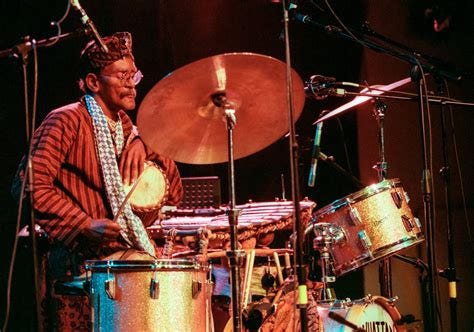
Photograph by Jack Vartoogian
This installment of my Chicago interviews is a conversation in September 1976 with Jerome Cooper, a remarkable drummer then most widely known for his work with violinist Leroy Jenkins and bassist Sirone in the Revolutionary Ensemble, which had issued four albums — Vietnam, Manhattan Cycles, The Psyche and People’s Republic. A year later, the group would disband, due primarily to scant employment. Cooper had already begun to expand his drumset into the sui generis drums-percussion-and-tuned-percussion assemblage that he would deploy in solo performance over the next decade, as documented on albums like Root Assumptions, The Unpredictability of Predictability, In Concert: From There to Hear, and A Magical Approach.
In 1988, Cooper released the excellent quintet album Outer and Interactions, with Joseph Jarman, Jason Hwang, Thurman Barker, and William Parker, who conducted an extremely informative interview with Cooper in volume two of Parker’s monumental oral history Conversations and Monologues. He also spoke at length with author Bob Gluck for The Miles Davis Lost Quintet : and Other Revolutionary Ensembles. In presenting this much earlier interview, I’ve stayed with the perhaps too literal word-for-word transcription that I generated in 1976.
******************************
Panken: Tell us about your formative years as a musician, about your early musical growth.
Jerome Cooper: One thing is that . . . O.K., I’ll start from where I was born. I was born December 14, 1946, and I started playing - my first instrument is drums - and I started playing drums when I was around 6 or 7 years old. I started taking music lessons when I was 10, from Oliver Coleman. Now I have key individuals in my life that were very great influences on me, musically. Oliver Coleman, my drum teacher, was one, and then I went to DuSable High School and studied under Captain Dyett, which was a great . . . I mean Captain Dyett was unbelieveable. I mean, like he . . . like he really turned me on to a lot of things about myself, you know, and that’s the most important thing about this music, is your state of mind. It’s not about how technically you can . . . how proficient you are on your instrument. Because . . . like I’m into numerology, because I deal with it as an aspect of music. Music is mathematics. And I’m into numbers on an aspect as symbolical, where each number has a certain meaning, and it’s a symbol. Now relating on that level, . . . well, let me say it like this. Captain Dyett was a great influence, and then . . . I mean, like Ted, like my Chicago thing, man, I mean . . . I just grew up in Chicago, I hung out with different individuals, you know, I mean on the South Side. I wasn’t a member of the AACM, although when the AACM first started I was playing with Troy Robinson, he plays alto, and he’s one of the members. As I recall, I mean, I was wiped out by . . . Art Blakey, like (laughs), I was tryin’ to get that together. So I was really into that, you know. But Troy - we had a group called the . . . what was the name? . . . I forgot. But it was a quartet. But I never became a member of the AACM, although I know most of the people in the AACM through time. Like while I was in Chicago it was a thing where I did a lot of different type jobs. I played with Chad Mitchell at the Happy Medium. I played with Oscar Brown, Jr., you know, at this time they had a club there called the Plugged Nickel, and I worked there with him. Then I was playing with different people - Oscar Brashear, Malary Nuringden, he played saxophone in Chicago and is a fantastic musician. There’s a lot of musicians in Chicago, man, who are really playing, but are not recognized because . . . Chicago is weird like that, it’s like Chicago is a good place to be from. It’s a good place to, like, study, and because the music thing there . . . there’s a lot of music happening on all levels, and so like the environment is very conducive for study or getting your music thing together. Once you get to a certain point, you’ve got to get out of there, ‘cause if you don’t, it will be downhill. You go to a certain peak, then you go downhill.
That’s not universally true, there are a number of creative musicians who’ve spent their entire working lives in Chicago and flourished, like Muhal Richard Abrams.
Well, considering . . . now, take Muhal. Now, Muhal’s like the founding father of the AACM. He is like, holding down the fort. I mean, it’s like a whole school there, and someone has to be there. On that level, he . . . I mean, like that’s the place for him to be at, that’s his function. On this planet, all of us have different spots. You have to find your spot, and for people like Muhal . . . well, his spot is in Chicago. Because there are a lot of creative musicians in Chicago who want to play, and by becoming a part of the AACM . . . I mean, you can’t beat that experience. But I’m saying that once you get to that level, and you get all you can out of that, it’s time to leave - if you want to get higher. Because ain’t no one place cool. I consider myself like a gypsy, I mean, an artist, a musician should be like that. Music is universal, and you can’t keep it in one place. If you try to keep it in one place, it becomes local. And so for certain individuals, like Muhal . . . Eventually what I want to do, is I want to get a house in the country. I don’t dig New York that much. I’m here just to get my thing over . . . and the Revolutionary Ensemble, we have a ten-year plan. In five years . . . we’ve been together for five years now, and that thing is together. We’ve got the music thing together, and now we’re talking about makin’ some money, playing creative music. Most people say, “Well, you can’t make any money playing that type of music.” Well, I think we can, and we are. So that’s what we’re going to do in the next five years. So I’m in Chicago.
Now basically, my thing in Chicago, like I said, I was playing different jobs, just like gigs . . . like, the reason I did that, the way I look at music - like, I dig all types of music. I dig classical music, I dig rhythm and blues. Anything that has that feeling, I can appreciate. And I try to incorporate that when I write music. I just don’t keep it . . . it’s just a thing where I dig all types of music. So in Chicago I was playing a lot of different type jobs. After the experience of going to DuSable, I went to New York. I was working with rock-and-roll singer named Tommy Hunt, and I played with him for about a year, and it was horrible! It was a learning experience, I mean, I learned a lot, but it wasn’t my thing. There was nothing . . . it didn’t get to the state of mind of individuals, certain individuals musician-wise, you know. I just wasn’t on that level. But I dug the music for the experience, it was cool, but I couldn’t function. So I went back to Chicago. So, OK, I know most of the musicians, I was playing around with different musicians. Then me and Kalaparusha, we had a group called The Light. We played some concerts down in Tennessee, Chicago . . . and during that time I was just playing with different people, that’s where I was at. And when I got to a certain point, I had to get to the point where I said, “I’m not really serious about this shit.” There are certain phases in my life where . . .
OK, I grew up, and I started playing drums at a very early age. I was a born drummer. So, OK, I started playing professionally when I was 14. I was makin’ gigs and so . . . like, it was easy! And when you approach shit like that, when it’s so easy, you’re not serious about it. So I wasn’t serious about it, man. And that was my whole attitude during that period. I mean, I used to have a period where I loved to play, that was my thing. But that had a catch to it. You have to find out what you want to play, why you’re out here playin’. I just loved to play. So I was getting involved with different people, playing with different people, but I didn’t really find myself - about where I was at. So in 1969 I went to Europe, with an idea that they dug jazz over there, creative music, but I found out different, it’s a whole ‘nother trip. I went to Copenhagen. Got up there, and got stranded. But then, it was another experience, because I believe . . . whatever situation you’re in, you should make the best of that situation. That’s the way I play my concerts, every concert. I don’t believe in bad concerts, because every concert is creative if you’re sensitive enough and in tune enough to take the positive aspects of the situation. So in Copenhagen it was a very weird situation. But the positive aspects of it were that . . . this is why I got into piano. Like, I’ve been into piano ever since I was born. My sister played piano, so we always had a piano around the house. But me, I wanted to play drums, drums was my thing, but I always used to like to hang around with the piano. So in Europe, in Copenhagen, I really got into it, because there wasn’t nothin’ else happening. It was really a drag. That’s when I got really seriously into the piano, and I got seriously into more of the music, what I want to play. So I was in Copenhagen, and I went up to (?), that’s a city up in Jutland, and I met this musician. His name was Tony Kovacs, a Hungarian, and we got a group together.
Had you been able to gig before that in Denmark? That has been a center of creative music in Europe.
In Denmark?
I had thought so, a number of people, like Dexter Gordon, have made homes there. . .
Now you must dig the situation. Now, creative music . . . Dexter Gordon is a creative artist, true. Now you must dig the situation of Scandinavia. Scandinavia is a very closed situation, they don’t know what’s happening outside of their little worlds. And the only thing they know for sure is what they read and what they from . . . what’s happening! Like if an individual is famous, and he’s done shit they know . . . where other people say he’s good . . . they know he’s good! They wouldn’t know he’s good by listenin’ to him, because they don’t know. OK, artists like Dexter Gordon, Ben Webster was there when I was up there, Dollar Brand was up there, who else? So I used to talk to Dexter . . . one of my great influences was Ben Webster, I mean, we used to sit and talk, man, and he would tell me, he told me some heavy things about the situation up there. They were killin’ that cat up there man! It’s a drag. I mean you have a great artist like Ben Webster, Dexter Gordon, and you put him with some punks! . . . you know, how much can you take? Really, man. And Ben was dying. I knew he was going to be dead in a couple of years, because he was going out of it, man. It was horrible, man . . . I mean, I’ve seen some sad situations, really. So . . . My thing was that when I was up there, they’d never heard of me. So I said, “Well, I play creative music”, you know - bam! - they heard me play it, they thought it was too weird. That’s what they said. And so I could never get a job. I only did . . . I can count the concerts on one hand. I was up there for six months and I did four concerts. I did a concert at the Montmartre one Sunday afternoon, it was this woman . . . she’s a booking agent. She got me that gig, you know, and then I did a couple of concerts in (?). But that was it. The rest of my thing was like practice. Now I wanted to go to Paris. I found that everybody was in Paris. But I didn’t have the money. So I just played up there . . . that’s another thing, you know, I’m religious in a way, but I’m not religious in establishment religion. I believe in the Creator, and I believe all of us have a certain mission down here, I believe all of us set up probabilities for ourselves, and that certain aspect of my life in which I was up there was for a reason. So it got to a point where I was completely out of it, and there was no other way for me . . . Roland Kirk came to town. He came to (?) and I got a gig with him. I toured Europe with him. I went to Finland, Norway, Switzerland, Germany . . . and we went to Paris, and played at the ORTF in Paris. I met Roscoe, I saw Roscoe, Joseph, and all of them cats, and they were talkin’ about, you know, it’s happening here, and I said, “Well, this is the shit,” you know. So I finished the tour with Rahsaan. I went on back to Paris, and Roscoe, another beautiful cat man, . . . there are certain individuals on this planet who are like teachers, of which you cannot find in no schools, you know. So Roscoe, he found me an apartment in Paris, where I could stay at, and as soon as I got there I did some concerts with the Art Ensemble. I worked at the Le (?), which is a jazz club in Paris, with Clifford Jordan. So I was content, I was playing. I was getting more and more . . . by that time I was definitely serious about the music. So I was playing. I worked with Steve Lacy over there, Robin Kenyatta. But I never really did any of my own concerts, because I never . . . like, I don’t consider myself . . . I don’t know, man. I just dig, really, playing music. But it got to the point where the only way I knew to get where I felt the music was happening was to deal within a unit. I got that idea over in Europe, and I knew that when I got back to the United States, I had to get into a cooperative unit, where we have a certain goal and mission. So I was in Europe about three years. Then I came to New York in 1971, in June. Roscoe gave me Leroy Jenkins’ phone number. I called Leroy up, went over to his house. At that time, Leroy and Sirone were into the Revolutionary Ensemble, and at that time they had Frank Clayton. Clayton . . . I don’t know . . . Clayton’s a good musician, and . . . no, I don’t even want to talk about that. So we knew . . . some very spiritual things I’m talkin’ about now . . . it’s like, in life you don’t meet people by chance. It’s like . . . certain missions you have to perform. I knew that I had to get into a cooperative group, by that time I knew what kind of music I wanted to be into, I knew . . . just certain things, bam!, had to be done. And I knew that New York was the next step - I couldn’t go back to Chicago because, like I said, you can only get a certain point in Chicago and then it’s gonna be down road. To me it is, at least, I can only speak personally. So I went to New York. We formed the Revolutionary Ensemble basically, I would say, October 10, that was our first gig. We did a concert at Loeb Student Center, N.Y.U., and so after that gig . . . we didn’t have no more gigs! (laughs)
What kind of critical reception did you get after that concert?
Wasn’t no critical reception, like there wasn’t no critics there to criticize. There were people there, but it wasn’t like . . . basically, man, for three years in New York, we didn’t work at all. We ain’t working now, but it was really rough then. But we knew we had to play. We have a certain thing that we would have to get across. So we would rehearse every week, from 12-5, Monday through Wednesday. We did that with no gigs, no money, people would laugh at us, say we was nuts. We could have worked if we had put somebody up there as a star, like Leroy and his Revolutionary Ensemble, we could have started working then, but we weren’t like that. Because the music - there ain’t no such thing as stars, first of all, ain’t no such thing as sidemen - it’s about individuals. If you can function within a unit, cool; if you can’t function within a unit, you function by yourself and you hire certain cats to play along with you. Then what happens to the music? It becomes sterile, one cat’s here, another cat’s over there. People can hear that. But with us, you hear the total sound, we are producing a total sound. And there’s not too many groups doing that. The Art Ensemble does it, Air does it to a certain degree . . . who else? I don’t know anybody else. So this is our idea that we’re trying to get across, basically . . . we was rehearsing and rehearsing, and there wasn’t no gigs.
Were you doing records at this time?
After about, I think a year and a half, we did a record for ESP called Vietnam I & II. Basically the record, musically, was very good - I mean, on a musical level - but technically it was horrible. At that time, we were associated - a friend of ours was a lawyer, and he dug our music, so he used to record us all the time. So this concert we did at the Peace Church was the first time he recorded us, and he didn’t really know what was happening. I mean, we just hit, and that’s what we usually do, hit, and when we hit, he didn’t . . . so the recording quality of that record is not good. And that was our first record. Then about a year after that we did another record, with him, Bob Cummins, called Manhattan Cycles. That was a concert we did at the St. Marks Cinema on New Year’s Eve. We had a thing where every year - if we didn’t work the whole year, we would at least give a concert New Year’s Eve. (laughs) So every New Year’s Eve we gave these concerts. Our first concert, actually, we used to do it at Ornette Coleman’s place, the Artist’s House. Matter of fact, we kinda opened that place up, because when we first gave a concert there, it was horrible there. Like, it was cold, wasn’t no heat. But after we gave a concert there, it was packed, so Ornette went and got the place fixed all up, he knew that he could make some money. So we did this concert at the St. Marks Cinema and we recorded the record Manhattan Cycles. Now the composition that was recorded was Leo Smith’s composition. You know how Leo is, I really love Leo’s writing, because he writes in colors. A lot of musicians actually won’t be able to play with him because he don’t write . . . you know, notes . . . it’s like a painting. Like, I’m into the same way of writing, but I’m more into, let’s say a legitimate way of writing, where I would have the staff and I would have certain notes. But Leo’s writing . . . I can really dig that . . . I mean that’s a heavy way of writing to me. That’s purely . . . you really gotta . . . the frame is laid down, you know, it’s all up to your imagination. Because there ain’t no definite notes. So that whole set was one of his compositions, “Manhattan Cycles”. It was very hip. At first I didn’t like it, to tell you the truth I didn’t like that, but after I listened to it awhile it was something else. So we went on and decided to make that our record. So, bam, we did that record, still wasn’t working. We did a couple of concerts, but it wasn’t enough to make no money, man, like all of us were on welfare and shit at the time. Everybody had their own things how to make money, but we wasn’t making no money playin’ no music. So after that record we did a tour of Sweden, in ‘74, which was unbelieveable. We did another record on our own company, because we have a certain theory about record companies. The Ensemble - all of us are distinct personalities. Everyone has had their own personality, that’s one of the key things about having a group like this. Each individual has to function on a high level. You cannot be leaning on other people. That happens in a lot of groups, they’re laying on one cat . . . I mean, each cat has to be an individual, has to contribute. You can’t let one cat go through all the work. Everybody has to contribute. So after the tour of Sweden, we did another record called The Psyche. We did that on our own company. We sold enough records over in Sweden, we took our ESP record over there, about 50 or 100 of Manhattan Cycles, sold them, and had enough money when we came back here to produce our own record on our own company. So we did The Psyche.
Now I have to tell you about my aspect of what I think about records. To me records are only paintings. Records are about attaining and about money, that’s all. When I deal with major companies, like A & M, Columbia, anybody - it’s a painting. If you want a painting, OK, what kind of painting do you want? How much money you got? You can get a $1000 painting, you can get a $5000 painting, $10,000, you can get a $50,000 painting. It all depends . . . that’s what it’s about with records. So in November, 1975, we met John Snyder. We decided we needed another record. But we still have our thing . . . like if we’re going to deal with a major company, we got to get some money. A lot of musicians just go out and give away the music! I mean, like you can go make a record for $100-$200 - just think how much money they make off of that shit. I’d rather not record, I ain’t into that, I don’t need it. Just like interviews. On that level I don’t want to be no star, or go out and do shit I’m going to feel bad about. I don’t do nothin’ unless I feel good about it, inside. And we felt very good about doing that record with A & M, although they haven’t really pushed it. But on the aspect of a painting, we sold them a painting, they can take it, and put it up on the shelf, and keep the motherfucker. I don’t care. We got the money we wanted, we gave them a perfect record . . . well, ain’t nothin’ perfect, but it’s a very good record, and what are they doing? They’re not even promoting it. We sold 10,000 copies, which is nothing - I mean usually they talk about 100,000 copies. But they’ve only printed up 10,000. So shit, man, I don’t know what’s happening, I’m at a point now, man . . . I just know that we’ve got to have certain things . . . first of all, every artist has to know the value of his art. Their art is themselves. You’ve got to know the value of yourself. If you don’t, OK, you can just go around and play gigs, and they don’t mean nothing. But once you put certain standards on your art, and certain . . . it becomes something, it has much more meaning to it. Like, we need another record, because A & M, the way I feel, they’ve just about cancelled on us.
Could you deal with some of the technical aspects of collective improvisation, compositionally and improvisationally?
Compositionally, each individual has to offer music toward the whole thing. Since you are dealing on a very personal level, even as a composer, . . . I mean, I wouldn’t want my music, just my music, to be played all of the time, because that’s just one color. So each individual should offer compositions, it has to be like that . . . for the total different color. Now for me as a composer, I’m into colors anyway. Through that, usually, I’m very analytical and almost . . . you could call me a psychoanalyst. I’m very perceptive about individuals and I’m . . . that’s the way I write music. I write for individuals.
Now I want to talk about that Mandel Hall concert (May 17, 1976). I think it would be better for me to talk about my compositions, because I know more about them than Leroy’s and Sirone’s. When I write, I write in colors, any kind of color I can think of. It’s very easy for me to write a melody, that’s the easiest thing I can do, but to take that melody and make a painting out of it becomes very hard. It takes time. You have to think about how the movements are, how it affects your movement to this next section. On that concert I did two compositions. I did “March, 4 & 1”, and I did “Android”. Now that “March 4 & 1” was basically into an aspect of time, where the first movement was bam!, 4/4 - piano, bass, and violin. The second movement was warmth - there we dealt with drums, violin, and bass. On a theoretical level, that is about as far as I can talk about it. The next composition was “Android” - now that composition, I wanted to get more into . . . like, how the name is, like an android, like a human robot. So I didn’t want no feeling whatsoever in this composition, I wanted it completely intellectual. And that’s a color. So basically it was structured . . . I wrote out a certain rhythm, in which we played with wood blocks, and we just dealt that with no feeling whatsoever. I didn’t want to put no feeling into it. I wanted it to be completely intellectual, and that is a color, right there.
OK, that’s compositional structure, how about the improvisational structure of your work. Can you explain how at various times you face a situation and deal with it musically?
I can tell you a certain type structure, I can give you an explanation. It’s like taking a space trip. Let’s say we’re getting ready to go to Jupiter. Now when you’re out in space you have certain, like say, space stations you have to stop at in order to re-group your spaceship and to find out the next direction. A big problem in this new music, or creative music, is that a lot of artists, they start playing free and you’ll be out there . . . I mean, that was one of my problems! That’s the reason I had to get into writing like this. I mean, cats just tell me to go on and play, and then you have egos and shit that goin’ to be happening. ‘Cause I don’t know what to do, I’m goin’ to play! And then where do I go? What do I do? - when I’m out in space, and everybody’s lost in space. So basically, the structural aspect of it is that you have certain colors, certain - whatever the color is. Rhythmic color, or harmonic color, or whatever. Where after this certain phase, after you have exploited this certain aspect of the music you know that you go here, to this certain aspect. Then after you exploit that one, you go there. Then after that, you usually have a melody, you just play the melody, and it’s over. I feel that that’s better, because when I was like into just playing, just playing man, I didn’t know what to do! And that happens a lot. And to me, it’s getting away from the Jazz way of structures. A lot of musicians who consider themselves creative musicians, to me, they just have the same old jazz structure. They write a melody, they take a solo, and they take the melody out. What is that? To me, he might as just get up and play “’Round About Midnight”, or some shit like that. I mean, it’s the same old thing, you play a tune and you improvise, and you play the tune on out.
So that’s not valid for you.
To me, in creative music, it’s not valid. To me, that’s just one aspect. When you deal like that, a lot of things can happen in the music. Like first of all, you play the tune - who takes the first solo? That’s what happens, who’s goin’ to take the solo? And right there, ego is goin’ to be jumping in. How long are you going to solo? What do I do after I take this solo? Who takes the next solo? Then what happens in this music is that, automatically, saxophone takes the first, trumpet takes the second, piano takes the third, and if its really happening, the bass or the drummer takes a solo. And then they take the tune on out. And that happens all the time, and what happens? The music gets boring. They’re not making full use of the collective thing that they’re in. I’m not downing that, you know, to me that’s great music. I’m just talking about . . . music has gotten on another level now where we are each individuals. Ain’t no more stars, ain’t no more sidemen. I mean, we’re talking about a thing where everyone will be able to express themselves and the music won’t get boring. To me, that’s what kind of got me bored with jazz, and I played a lot of jazz. I mean, it always just went like that. You played a melody, saxophones take the solo, and usually with shit like that there ain’t no work involved. I know when we play concerts, whenever I play a concert, I have to write some music for it, because I’m into that. If I don’t, I end up . . . I don’t know what to do. I don’t know what to do. (laughs) OK, I could get up there and play, and I could improvise - that’s easy - you can play all day, but you might as well make use of it, make really good use of it. Take all of the Revolutionary Ensemble records, and none of them will sound the same. Every one of them is different. Every time we play it’s different. It’s never the same, never the same, because we work and we structure. All that shit is structured, man. We’re not up there playing free music, we don’t consider ourselves free musicians. If we want to call it anything we call it discipline music or controlled music, but there’s no free music happening anymore, to me. So that’s my aspect of writing. Like you’re dealing with a lot of freedom, man, in improvisation you’re dealing with a lot of space, and with that much freedom you’ve got to have some discipline. It has to be structured, and if it’s not structured, other kinds of impurities, other shit can happen, and I don’t dig that happening. And most of the creative musicians I know are into structure - Leo Smith, Anthony Braxton, Roscoe Mitchell, Joseph Jarman - them cats are into, like, disciplined music.
Let’s talk about the other instruments in your repertoire besides drums - the African instruments, the balafon, for instance. Also, how you utilize them.
I have to be attracted to an instrument. The balafon I was attracted to because it was basically a percussive type of instrument, and I dig the sound of it. It was given to me, someone gave it to me. So how I utilize it is that I write music for it. I will just use it in a composition, as with all my instruments. That’s another thing. I just can’t get up and just start to play anything. I have to know what to be playing. I can give you an example. I have a friend, a very good drummer and he’s a great musician. But one of his problems is that when he plays it comes to the point where he’s almost like demonstrating his instrument, because he doesn’t really get into each one of them. Like he plays the whistle, you know, beautiful, but he doesn’t get into it, and the reason for that is because when he gets up there and does a concert there is no thought or no work really involved into it. It’s like, when I play, I have to know . . . I just don’t play them for the sake of playing them. I mean, I have to know certain structures. Like each instrument has a certain color, and that’s all it is. I don’t like to be working too much outside of the Revolutionary Ensemble, to tell you the truth, but I have some music I’ve written. I have a solo composition I did, and I have a duo thing I did called “Spectacle Percussion”. I performed with (?) the other day. He deals with pre-Columbian type instruments. In fact, that’s the cat I was talking about, about how he plays. He has all these instruments, and he doesn’t really get into any one of them. I mean, he plays them though, but . . . so I went on and made the gig with him, and on that concert I took my balafon. I wanted to really get into playing the balafon, stretch out on it. Instead of just playing it, I wanted to stretch out. Because to me, the balafon is just like the alto saxophone or tenor, it can be stretched out on. You can do almost a solo performance with it, with any of them, flutes too. So I just took my flutes and my balafon, and my saw and my cymbals, and it was an unbelieveable concert. Unbelieveable. I just really learned . . . I’m learning, Ted, it’s hard for me to talk about such things (laughs) because what I say right now will be completely different in five years. I know it. Next year, it will be a whole nother thing. So I can only talk in periods, for the moment. Certain times I can talk about all the times, because when you talk about spiritual things it’s timeless, there’s no such thing as time. Just like the Ensemble, we got a letter from England from this writer. He wanted to ask us this question - I think it’s a very good thing - because he wants to know what happens to time in improvisation. Now I’m not even going to answer that, but basically what happens to time is that it’s on an individual level. Because really, there’s no such thing as time. There’s no time. Time is what you make it. Everybody puts themselves in different time zones, but it’s just like an illusion, an illusion of time. There’s really no such thing as time. I can get more profound about that. Basically, we’re all down here functioning on a physical-type level. I mean, on a physical level there is an illusion of time, there is an illusion of structure, because that’s what we’re into. But really, it’s not even there, there is no such thing as time. I’ll give you an example. Have you ever been in a situation where, let’s say, you almost died? Were you ever in a very critical-type situation. Or let’s say in dreams - dream reality is as valid as this reality. You can live 20 years in 2 minutes. . . I mean, really, you have gone through 20 years. That’s very important, because like, to me, what’s wrong with a lot of people in this society is that people, they be talkin’ a lot of things, you know, and the problem is the perspective of the shit. Like I’ll be reading abortion laws, and how music should be played, and what’s this is that and what’s that, you know what I mean? And it’s very true, on a physical level. But we’re trying to get to the next stage, for we have to get away from that level. You have to be able to see things beyond the physical level in order to create another physical reality. Most people, everybody’s stuck into that same old thing, “this is like this”, and it’s true! But it’s not true, because the perspective is thrown off. Mostly, I know that when we do concerts, most people who come, they don’t even know . . . like, they never heard of us. Like, we did a tour, we went to Germany last March for this free music association in Berlin. Right then and there, we wasn’t supposed to be there, because we don’t play no free music. And they had all these free musicians up there, up there playing free music. It was horrible, it was chaotic like a motherfucker. So when we got there, man, they loved it, loved it, we wiped them. And that’s what we usually do every place we go, because they don’t even know . . . what about us. They don’t know - “who are these?. .” - they hear the music, that’s all that we’re about. Music. I’m not about talking, you know, I can talk, but basically I express myself purely in the music. If you really want to know what’s happening, just listen to the music. That’s what it’s all about, you know. That’s about my writing, that’s about my outlook, my function within the Revolutionary Ensemble, it’s about my whole life. The music. I mean, I can sit up here and talk words, and words are basically very physically oriented. And everything that’s physical is only for the moment, nothing stays alive physically. Everything dies. Only emotional experiences survive, only spiritual things survive. So like, me talking words don’t mean nothin’. They mean certain aspects for the moment, like I say, people be listening to this, let’s say they want to learn, to play. But basically the best thing I can say about them is to get into themselves. That’s the way to do it.
You said before that you saw possibilities of making money playing creative music.
One of our things in the Ensemble, that we’re into now, in the next five years playing, we want to make some money. Because individually, all of us have our own things we want to do. I don’t want to make a lot of money, I’m not into money like that. Really, I wish it was just on a point where people didn’t even have to pay to come to concerts. If I could live without payin’ the rent and without buying food, I wouldn’t charge no money for concerts, man. That’s a Sagitarian idea, but it can never be. Not in this type of society. We’re dealin’ with a capitalist society - that’s not even a reality that will ever become a reality. So basically my thing, is I want to make a quarter-million dollars within 5 years. I want to have it in the bank. The reason I want to have that much, well, that’s the only way I can live. I want to get a house in the country, I want to live in the country, I want to write music, and I want to get to the point where the Ensemble can do a lot of benefit concerts, where people won’t have to come and pay. We can do it, where we wouldn’t have to charge a certain amount of money, because we’re cool! We wouldn’t have to do that. And the only way I can see it right now is through record companies.
I’d just like to say - this interview, you were talking about it - the only insight I can really give is that everyone sets up their own probabilities in this reality. That’s why we’re talking about getting into the music. You have to get into yourself. You cannot be in competition with other individuals. You cannot say, “he’s doing that, so I want . . .”, you can’t do that. As soon as you get into that ego, that disrupts the music. You have to get into your thing. And that’s the thing I want to get into and elaborate on, because within this music there’s a thing in Chicago. Chicago’s a very nationalistic-type city. I mean, the black community is very much - you know how Chicago is, you can’t be running out a lot of (?) in Chicago! (laughs) So in a way, that’s pretty good. You get to develop a certain-type consciousness, and so the music is a certain way. Because the music . . . the only thing we’re playin’ is where our minds are. We don’t play nothin’ else. You cannot go to school . . . you go to school 20 years, and learn all the theoretical aspects of the music, but if your mind ain’t there, you may never be able to play it. You will always sound like a dictionary. To me, that is one of the frustrations for a lot of young musicians. If they got more into their music it would be much cooler for themselves. Instead of trying to play like other people. You can’t do it. I used to be like that. I used to try and play like Art Blakey. You can’t do it. You try to play like that, it becomes ego music. You go and hear that shit, and instead of coming out and feeling cleansed, you go out with a headache, and shit. I’m not downing study, because everyone should study. Like, I practice all the time. I go through scales, I do it all the time. I do it 6 or 7 hours a day. That’s why I have this place (an enormous loft room in the garment district of Manhattan). I can’t even afford this place, but I knew I had to have place in order to practice and work. But when it comes time to play the music, I just play Jerome Cooper, that’s what I am. I am Jerome Cooper. That’s what I play. I don’t play no drums, I don’t play no piano, I just play Jerome Cooper. And I know from experience, a lot of people will be wondering what do I do? Who am I? What does he play? The only way I can say it is I play Jerome Cooper, I play where I’m at. That’s it. Everyone, if they got into that level, an aspect of that level of the music, the music would be much better. Instead of trying to play like somebody else . . . you’ll always feel frustrated, and you’ll always feel like you’re not there. Then you’ll start thinking low about yourself. It’s not like that at all. You just go on, and even if your music is what other people call rinky-tink, or whatever . . . but it’s valid. And that’s another thing about when I write. Like when I was telling you about “Android”. That aspect, I didn’t want any feeling. That is music. An aspect of no feelings whatsoever, purely theoretical shit. It is a valid music. That’s why classical music is valid, that’s why all music is valid, because like, they’re into it and . . . that’s aspects of the music.